A practical, layer-by-layer guide to the AI stack that separated high-growth e-commerce brands from everyone else, and what it means for how you build in 2026.
TL;DR: E-commerce brands that systematically deployed AI across acquisition, conversion, retention, and operations in 2025 earned 40% more revenue than those that did not. The AI-enabled e-commerce market reached $8.65 billion in 2025 and is projected to hit $74.93 billion by 2035. This article breaks down the four-layer stack that produced those results, the specific tools, the metrics that matter at each layer, and the sequencing that made the difference between compounding returns and expensive chaos.
The Stack Is No Longer Optional
If you ran an e-commerce business in 2025 and were not systematically deploying AI across your growth operations, you were not competing on a level playing field.
The global AI-enabled e-commerce market reached $8.65 billion in 2025, growing at a 14.6% compound annual rate. Projections place it at $74.93 billion by 2035. But market size figures are almost beside the point for operators. What matters at the revenue level is this: companies using AI personalisation earned 40% more revenue than those without it. Traffic from generative AI sources to U.S. retail sites increased 4,700% year-over-year by mid-2025. AI-driven revenue-per-visit increased 84% in the first seven months of the year alone.
These are not marginal improvements from incremental tooling decisions. They are structural advantages that compounded throughout the year and are continuing to compound into 2026.
This article is a practical guide to the stack that produced those results, organised by function, anchored in data, and built around the question that actually matters to operators: which tools, in which order, wired together in which way, move revenue?
How to Think About a Growth Stack
Before naming a single tool, the framing matters.
The most common mistake e-commerce teams made with AI in 2025 was treating it as a collection of individual apps rather than a system. They adopted a personalisation tool here, a chatbot there, an AI ad creative platform somewhere else, without designing how those layers would communicate, share data, and compound on each other.
The brands that won did something different. They built a growth stack: a deliberately sequenced set of AI-powered capabilities, each mapped to a specific revenue outcome, integrated so that the outputs of one layer informed the inputs of the next.
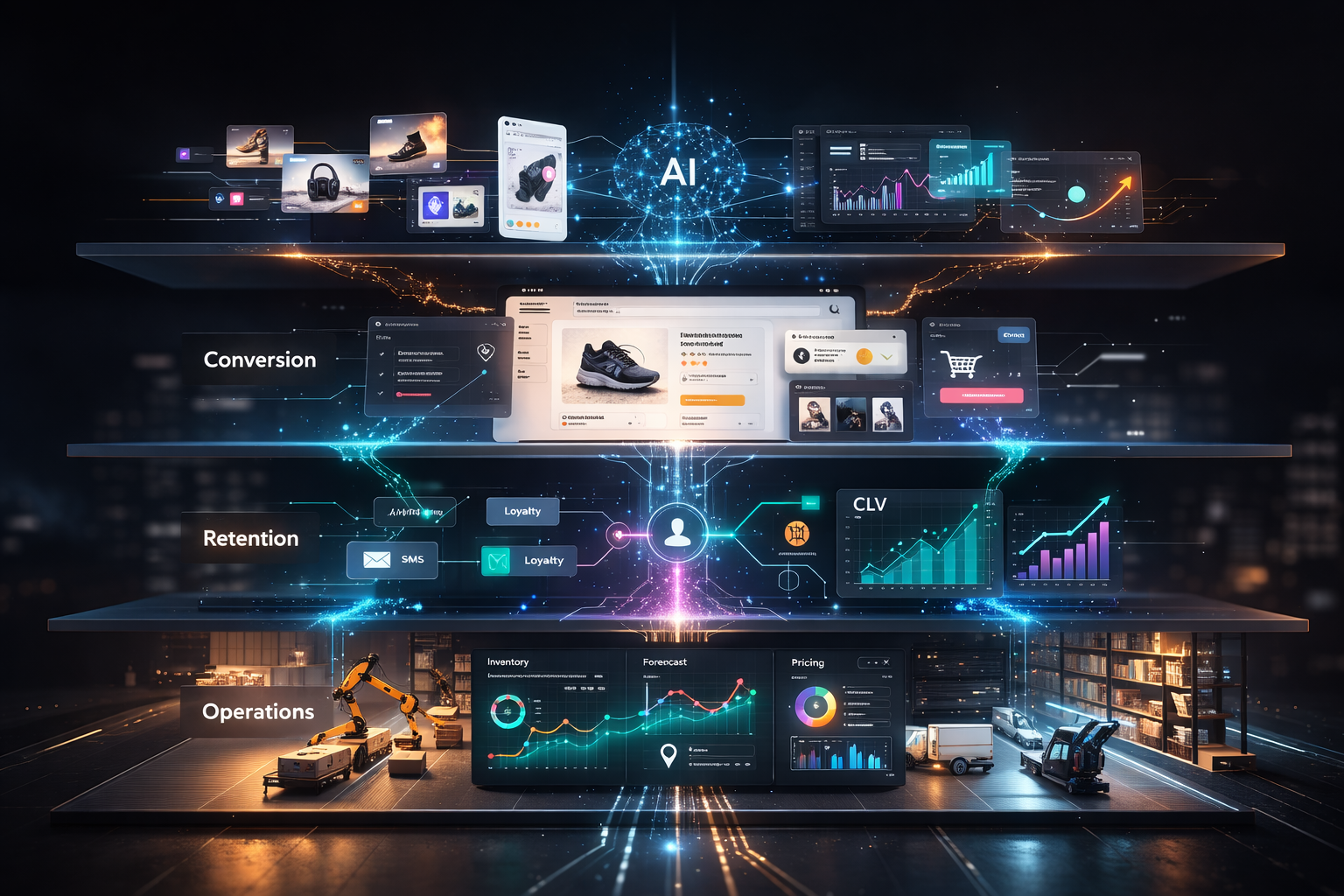
The framework for that stack has four layers, each addressing a distinct stage of the commercial relationship with a customer.
- Acquisition: Getting the right customers to your store efficiently.
- Conversion: Turning visitors into buyers at higher rates and higher order values.
- Retention: Maximising lifetime value once a customer is in your ecosystem.
- Operations: Protecting margin and enabling scale through AI-powered efficiency.
Each layer has its own tools, its own KPIs, and its own integration logic.
Acquisition: Smarter Paid Media and AI-Powered Discovery
Paid Creative at Scale
The traditional bottleneck in performance marketing was always creative. Media buying could be automated algorithmically for years, but generating the volume and variation of creative assets needed to feed those algorithms required expensive human production cycles. AI creative tools broke that bottleneck in 2025.
Ad campaigns with AI-powered automated optimisation deliver 30% better cost-per-acquisition compared to traditional methods. Platforms like AdCreative.ai, trained on over 100 million ads, generate and score ad variants with performance prediction scores before a single dollar of media spend is committed.
Pencil AI creates high-quality video ads in minutes and applies predictive analytics to estimate performance before launch. The feedback loop that previously took weeks now completes in hours: generate variants, test, identify the winning hook, scale the winner, iterate.
For brands running performance marketing at scale, where creative refresh cycles are measured in days rather than months, this is not a marginal efficiency gain. It is the difference between a profitable acquisition channel and a loss-making one.
Generative AI as a Discovery Channel
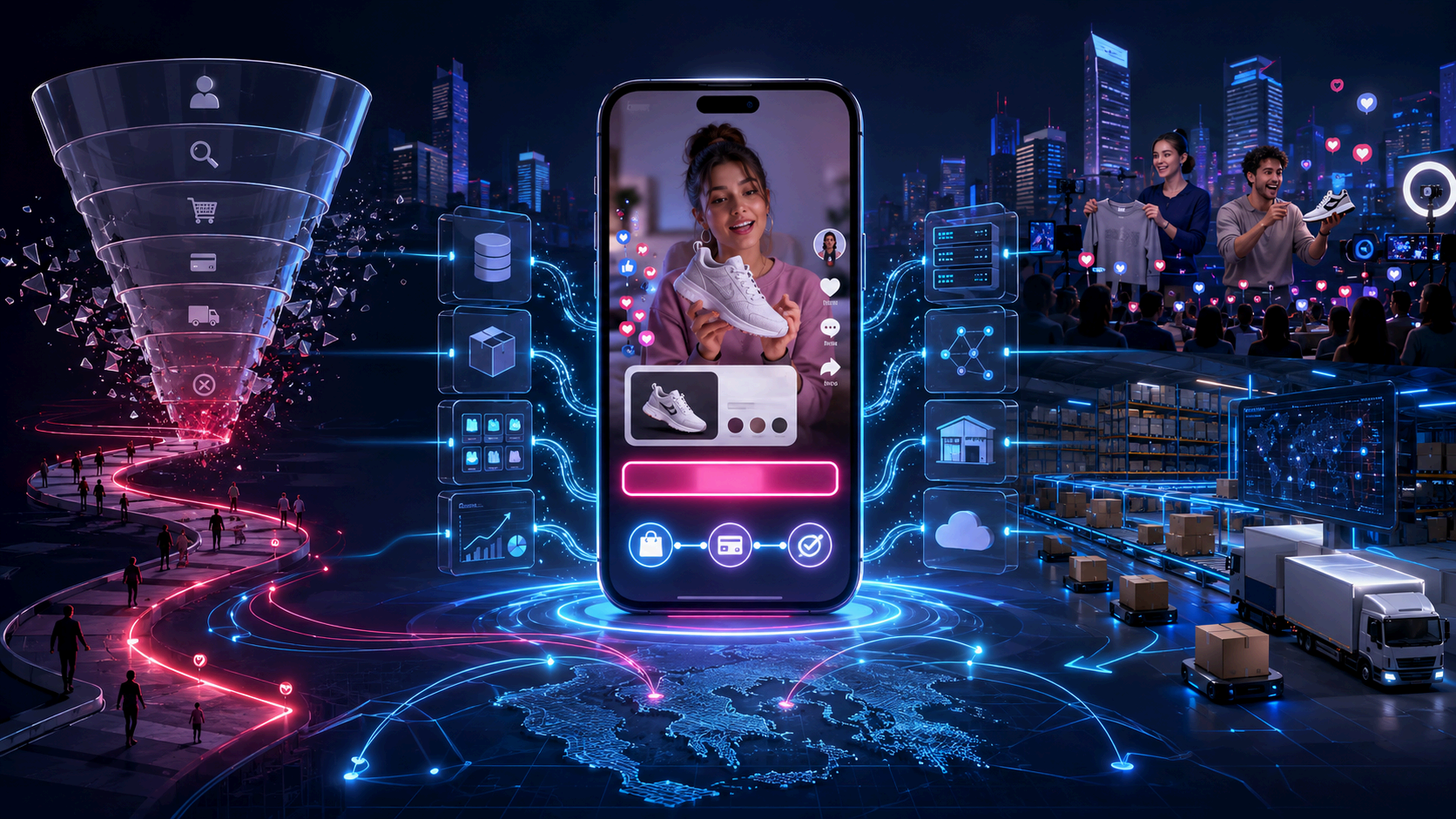
One of the most consequential acquisition shifts of 2025 was the emergence of generative AI as a product discovery engine. Consumers increasingly began their shopping journeys inside ChatGPT, Perplexity, and Google's AI Overviews, asking questions and receiving product recommendations rather than typing keywords into a search bar.
Traffic from generative AI sources to U.S. retail sites increased 4,700% year-over-year by July 2025. Shoppers arriving from generative AI sources demonstrate 10% higher engagement, 32% longer visits, and a 27% lower bounce rate than those arriving from traditional channels, meaning AI-referred visitors arrive with stronger purchase intent and clearer product requirements.
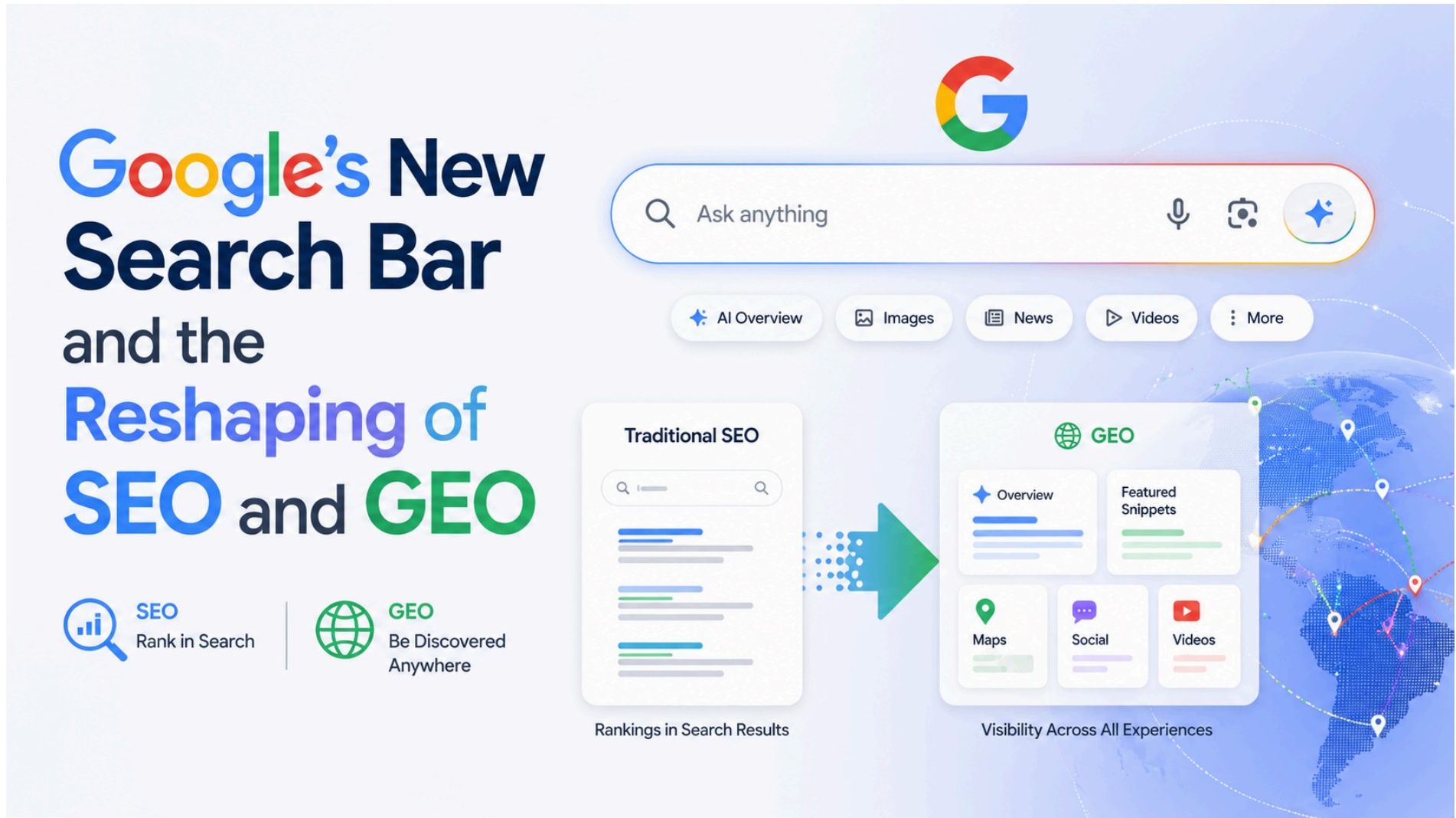
The brands that captured this traffic built content architectures designed to be cited by AI systems: structured product data, clear attribute taxonomies, strong review signals, and authoritative category content. This is no longer just an SEO consideration. In 2026, it is a core acquisition strategy.
Paid Media Intelligence Platforms
Beyond creative, AI-powered paid media management platforms advanced significantly in their ability to connect ad spend directly to downstream e-commerce outcomes. Tools like Madgicx provided advertising intelligence specifically focused on e-commerce metrics (ROAS, customer lifetime value, and incremental return) rather than the generic campaign metrics that dominated earlier ad tech. The integration between these platforms and e-commerce data created closed-loop measurement that made budget allocation decisions dramatically more precise.
Conversion: Turning Visitors Into Buyers at Scale
Personalisation Engines
Amazon attributes 35% of its total revenue to its AI-powered recommendation system, which analyses over 150 factors including browsing history, purchase patterns, and real-time behaviour signals. Customers who engage with Amazon's recommendations spend 29% more per session and show 73% higher customer lifetime value compared to those who do not.
In 2025, that capability became accessible to brands operating at a fraction of Amazon's scale. Platforms like Nosto, Dynamic Yield, and Bloomreach deployed machine-learning personalisation across product recommendation carousels, search results, landing pages, and promotional offers, adapting in real time to each individual visitor's behaviour.
AI-powered personalisation boosts conversion rates by up to 23%. Product recommendation engines increase average order value by up to 50% and revenue by up to 300% when fully deployed. 70% of retailers that invested in personalising their customer experience saw an ROI of at least 400%. That last figure is what moved personalisation from an enterprise luxury to a growth-stage imperative in 2025.
AI-Powered Site Search
Search is one of the most underleveraged conversion levers in e-commerce, and one of the areas where AI delivered the most reliable, measurable lift in 2025. Traditional keyword search is literal; it finds what you searched for, not what you meant. AI-powered search understands intent, handles natural language queries, accounts for synonyms and category relationships, and surfaces the most relevant product even when a customer's query is imprecise.
Tools like Algolia, Searchspring, and Klevu advanced their NLP-powered search capabilities significantly throughout the year. For brands with large catalogues, where search drives a meaningful share of product discovery, the improvements in search-led conversion were immediate and measurable.
Conversational Commerce and AI Sales Agents
AI chat delivers approximately 4x higher conversion rates, 12.3% versus 3.1% without AI assistance. Shoppers complete purchases 47% faster when assisted by AI tools. AI-driven proactive chats recover 35% of abandoned carts. These are the headline numbers from conversational commerce in 2025, and they explain why AI sales agents moved from an experimental feature to a standard conversion layer for serious e-commerce brands.
Platforms like Rep AI, purpose-built for Shopify, and Tidio's Lyro AI Agent demonstrated that well-implemented conversational agents could recover a significant portion of revenue previously lost to unanswered pre-purchase questions, product uncertainty, and checkout friction.
For context, the Baymard Institute estimates that $260 billion in lost orders are theoretically recoverable through better checkout optimisation in the US and EU alone. Conversational AI is one of the most direct paths to that recovery.
Post-Purchase Upsell
Post-purchase pages, the thank-you screen and order confirmation, were among the most underutilised real estate in e-commerce for years. Tools like ReConvert changed that in 2025 by deploying AI to turn these passive confirmation moments into active revenue opportunities: dynamically surfacing complementary products, personalised bundle offers, and time-sensitive loyalty incentives based on what a customer had just purchased and their predicted next-purchase behaviour.
Retention: Building Lifetime Value With AI-Powered Lifecycle Marketing
Email and SMS - Predictive, Not Just Automated
Email marketing still delivers some of the highest ROI in digital marketing, and AI fundamentally transformed what it was capable of in 2025. The shift was from rules-based automation, which relied on human-defined conditions and sequences, to predictive orchestration, where AI analysed each customer's behaviour, predicted their likelihood to purchase, churn risk, and lifetime value, and automatically triggered the right message at the right moment.
Personalised emails generate 6x higher transaction rates than generic broadcast campaigns. Automated triggered emails, abandonment recovery, welcome series, and post-purchase sequences, drive over a third of total email revenue despite representing a tiny fraction of total email volume.
Klaviyo remained the dominant platform in this space, with its predictive analytics enabling flows built around individually calculated optimal send times, predicted replenishment windows, and churn risk scores. Omnisend and Klaviyo together covered the majority of mid-market e-commerce brands deploying serious lifecycle marketing in 2025.
AI-Powered Loyalty and LTV Programmes
Static, points-based loyalty programmes showed their age in 2025. AI-driven customer experiences increase customer lifetime value by 33%. Customers successfully recovered through personalised retention campaigns show a 56% repeat purchase rate, significantly higher loyalty than average buyers.
The brands winning on retention deployed AI to make loyalty dynamic, adjusting tiers, offers, and incentives based on individual CLV predictions, churn risk scores, and purchase frequency patterns in real time.
AI-powered loyalty systems could identify the moment a customer's engagement was declining before it became churn, and deploy the precise intervention most likely to re-engage that specific individual: a personalised offer, an exclusive access moment, or a relevant product recommendation timed to their predicted replenishment window.
The Personalisation Perception Gap
One important caveat that every retention team should understand: 71% of retailers in 2025 believed they excelled at personalisation, but only 34% of consumers agreed. This gap represents both a risk and an opportunity. Brands that closed it, by building personalisation that customers genuinely experienced as relevant rather than just deploying the technical infrastructure, captured disproportionate loyalty and lifetime value. Those that did not spent heavily on tools that underdelivered on their commercial promise.
Operations: Protecting Margin With AI-Powered Efficiency
Demand Forecasting and Inventory Management
Inventory is where e-commerce margin dies quietly. Stockouts lose sales to competitors. Overstock ties up capital and leads to margin-eroding discounts. Traditional demand forecasting, based on historical averages and human judgement, was not responsive enough to the volatility of 2025's consumer markets.
AI forecasting cuts stockouts by up to 65% and reduces warehousing expenses by 10–40%. Brands deploying AI inventory management reduce average stock levels by 35% while maintaining or improving product availability, less capital tied up in inventory with no sacrifice in customer experience.
Platforms like Cin7, with its ForesightAI capability using over 100 algorithms to forecast demand up to two years ahead, and Prediko for Shopify brands brought SKU-level accuracy that was previously only accessible to large retailers with dedicated data science teams.
Dynamic Pricing
AI-driven dynamic pricing engines boost profit margins by up to 25%, increase average order value by 13% during peak periods, and reduce overstock by 6% in a single quarter. These figures are drawn from Onramp's e-commerce case studies and represent results from properly implemented deployments, not theoretical projections.
The key word is properly. Dynamic pricing without guardrails, particularly in consumer goods categories where price sensitivity is high and price memory is long, can damage brand perception. The brands that deployed it most effectively in 2025 used it to optimise margin on lower-visibility SKUs and to manage demand during high-traffic periods, while maintaining price stability on the hero products customers benchmark against.
AI-Powered Customer Support
AI tools in e-commerce deflect 20–50% of customer support tickets. In mature implementations, 93% of customer questions are resolved without human intervention, while customer satisfaction simultaneously increases by 25%. Platforms like Gorgias, purpose-built for e-commerce helpdesks, combined deep Shopify integration with AI agents capable of resolving tickets, modifying orders, processing refunds, pulling discount codes, without human involvement.
The caveat is real: 40% of shoppers still express frustration over the absence of human assistance in AI-powered customer service. The best implementations in 2025 were not those that removed human agents. They were those that deployed AI to handle high-volume, low-complexity interactions while routing genuinely complex or emotionally sensitive cases to humans immediately. The distinction is not automation versus people, it is intelligent triage.

The Integration Layer: Why Wiring Matters More Than Tool Selection
One of the most important lessons from 2025's e-commerce AI deployments was that tool selection mattered less than integration architecture. A best-in-class personalisation engine that cannot access real-time inventory data will recommend out-of-stock products. An AI email platform that cannot read purchase history will send irrelevant campaigns. A dynamic pricing tool disconnected from your demand forecasting system will make pricing decisions based on incomplete signals.
The brands that extracted the most value from their stacks built what practitioners called a "golden path" dashboard: a unified view of PDP conversion, cart adds, AOV, revenue per visitor, support resolution time, and return rate, fed simultaneously by all layers of the stack. Your e-commerce platform, Shopify, BigCommerce, or Magento/Adobe Commerce, is the foundation of this integration architecture. The question to ask of every tool before adopting it is not "what does it do in isolation?" but "how does it communicate with everything else?"
The Implementation Framework: Sequence Matters
Deploying all four layers simultaneously is a reliable path to overwhelm and wasted budget. The sequencing that produced the best results in 2025 followed a consistent logic.
Phase 1: Acquisition and Conversion Fundamentals
Start with AI ad optimisation and content creation, these deliver the fastest, most measurable results. Then layer in AI-powered site search and a basic personalisation engine on product and category pages. Most e-commerce businesses can complete this phase within 30–60 days.
Phase 2: Lifecycle Marketing
Once conversion is optimised, build the retention layer: predictive email flows, AI-powered segmentation, and post-purchase upsell. This typically follows Phase 1 within the same quarter.
Phase 3: Operational AI
With the customer-facing stack stable and performing, deploy demand forecasting, dynamic pricing, and AI support automation.
Phase 4: Integration and Intelligence
Build the unified data layer that connects all three previous phases and creates the compound effects that separate scale-stage brands from growth-stage ones. This phase is ongoing.
The Honest Caveats
No account of AI in e-commerce in 2026 should omit the failure modes.
Data quality is the prerequisite most brands underestimate. AI is only as good as the data you feed it. Customer data that is fragmented, inconsistent, or incomplete does not produce accurate predictions, it produces confidently wrong recommendations. Before implementing any AI personalisation or forecasting tool, the most important investment is data infrastructure: clean, unified, real-time customer and product data.
The skills gap is wider than most teams acknowledge. Only 17% of marketing professionals received comprehensive, job-specific AI training in 2025, even as 68% of them were using AI tools daily. The tools exist and are broadly accessible. The expertise to deploy them with genuine strategic intent is considerably rarer. This is precisely where working with a partner who has real implementation experience, not just tool access, makes a measurable difference to outcomes.
Consumer trust has clearly defined boundaries. Only 34% of shoppers are willing to let AI assistants make purchases on their behalf. 21% doubt the dependability of AI-generated recommendations. Deploying AI without transparency, without making customers feel the technology is working for them rather than on them, carries real and measurable brand risk.
The Stack Is Built. The Question Is Execution.
By the end of 2025, the AI growth stack for e-commerce was no longer a frontier technology problem. It was an execution problem. The tools existed, were proven, were broadly accessible, and had well-documented ROI benchmarks across every layer.
69% of retailers who implemented AI in 2025 reported revenue increases directly traceable to AI use. 72% experienced cost reductions simultaneously. What separated the brands posting 20–40% revenue growth from those posting flat numbers was not access to better tools. It was the discipline to implement them in the right sequence, integrate them properly, measure them rigorously, and build the internal capability to operate them with strategic intent.
As we move through 2026, that gap is not shrinking, it is widening. The brands that built the stack in 2025 are now compounding the data advantages it generates. The brands still evaluating whether to start are competing against an opponent who has been training for a year longer.
The stack is not the strategy. But without the stack, the strategy does not scale.
Resources
- EComposer, AI in eCommerce Statistics 2025: 80+ Adoption, ROI & Market Trends: ecomposer.io
- Conjura, The 8 Best AI Tools for eCommerce in 2025: conjura.com
- Feedonomics, Top AI in eCommerce Business Trends (2025): feedonomics.com
- Madgicx, AI Marketing Tech Stack Guide for E-Commerce Growth in 2025: madgicx.com
- Madgicx, 15 Top AI E-Commerce Platforms for Revenue Growth (2025): madgicx.com
- Absolute Web, AI Tools for eCommerce (2025): What to Use and Why: absoluteweb.com
- Envive AI, 63 AI Personalisation in eCommerce Lift Statistics: envive.ai
- Envive AI, 46 E-Commerce AI Implementation Statistics That Define Digital Success in 2026: envive.ai
- Envive AI, 32 AI Investment in eCommerce Statistics: envive.ai
- Anchor Group, AI in E-Commerce: 16 Key 2026 Trends & Stats: anchorgroup.tech
- HelloRep AI, The Future of AI in eCommerce: 40+ Statistics on Conversational AI Agents for 2025: hellorep.ai
- EComposer, How AI Personalisation Is Transforming eCommerce in 2026: ecomposer.io
- Contentful, 39 eCommerce Personalisation Statistics to Inform Your 2025 Strategy: contentful.com
- Cimulate AI, The Top 25 Digital Commerce Statistics to Know for 2025: cimulate.ai
- Glowtify, Top 10 AI Tools for Smarter eCommerce in 2025: glowtify.com
- Dragonfly AI, The Best AI Tools for E-Commerce in 2025: dragonflyai.co
- Sider AI, AI for E-Commerce Tools: The 2025 Stack That Actually Moves Revenue: sider.ai