TL;DR At Google I/O 2026, Google announced the most significant change to its search interface in 25 years: a conversational, AI-first bar powered by Gemini 3.5 Flash that routes users toward synthesised answers rather than ranked blue links. For SEO and GEO practitioners this accelerates a shift already well underway.
Position-one click-through rates on AI-enhanced queries have already dropped from 27% to as low as 11% (SISTRIX, March 2026). Ahrefs data shows AI Overviews appearing on 48% of all Google queries, up from 34.5% in December 2025. And Google's own official optimisation guide, published just four days before I/O, formally declared that GEO and AEO are not separate disciplines, they are SEO applied to an AI environment.
The professionals most at risk are those who built their workflow around keyword volume and blue-link click traffic. Those best positioned are those who already treated original authority and genuine expertise as the product.
What Google Actually Changed
On 19 May 2026, during the opening keynote of Google I/O, the company's head of Search, Elizabeth Reid, described a complete redesign of the search interface, calling the result "AI search through and through."
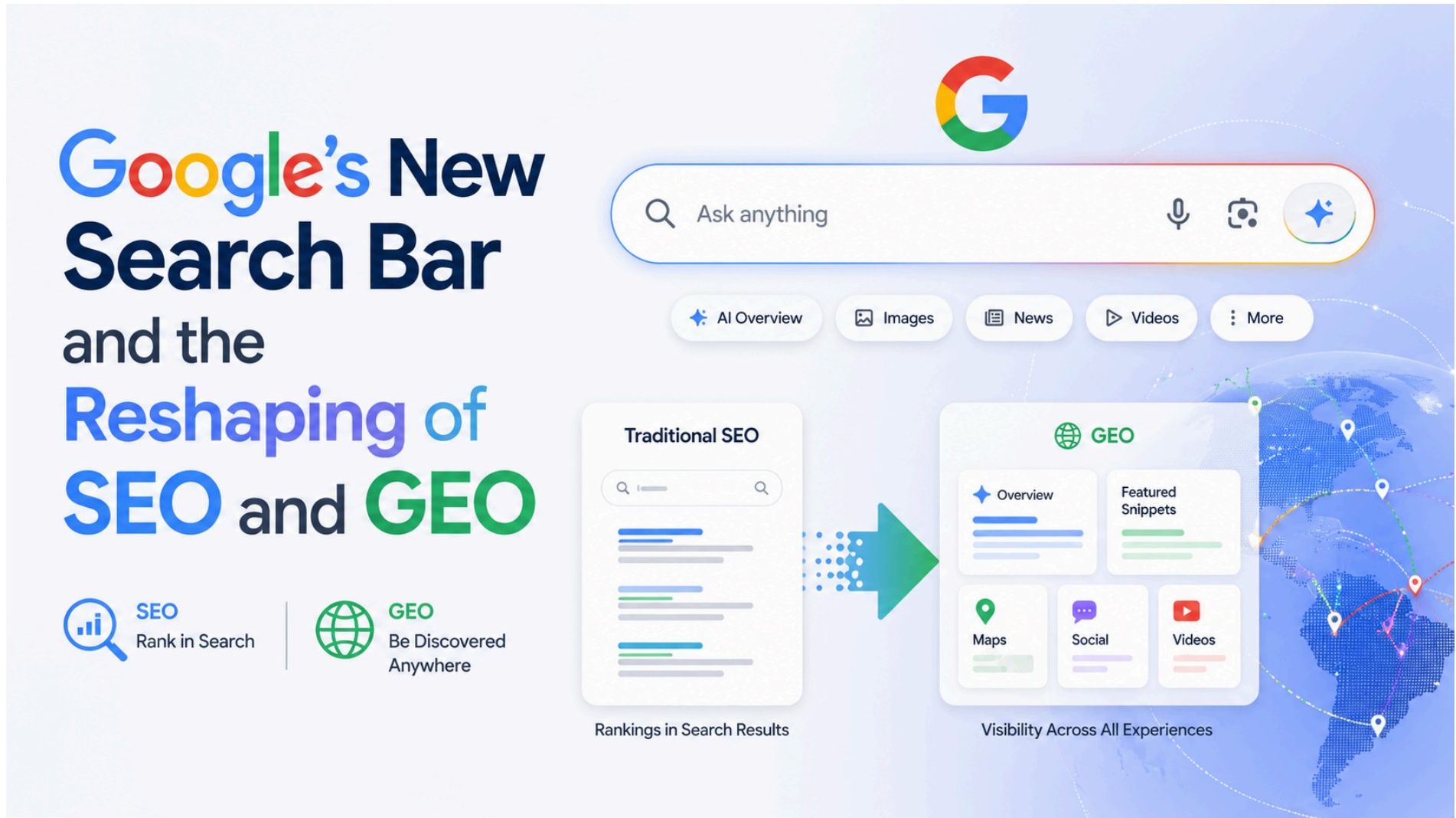
The search bar itself, largely unchanged since Google's founding, has been expanded and made multimodal. Users can now submit text, photos and video in a single query, and an AI-powered autocomplete helps formulate longer, more specific questions rather than sparse keyword fragments.
The underlying engine for these conversational responses is Gemini 3.5 Flash, a model Google described as faster and less computationally expensive than its predecessor, enabling it to serve billions of queries at scale. Responses no longer appear above traditional results as an optional overlay: in many query types, AI Mode effectively becomes the default surface, with a continuation thread allowing users to refine their search through conversation without ever reaching a third-party website.
What this looks like in practice
A plumber searches "tap repair instructions." Old Google returned ten blue links: a YouTube video, a DIY forum, a plumbing supply retailer, a home improvement blog. The plumber clicked two or three. Traffic was distributed across the web. New Google immediately answers: "Your tap is most likely worn washers or a faulty O-ring. Here are the four steps to diagnose it." The plumber gets the answer. The DIY forum gets nothing.
The practical shift is not that Google became smarter. It is that the interface now treats the blue-link list as a last resort rather than the default output. For the user, the experience is faster and cleaner. For every publisher who depended on that click, the economics changed.
Information Agents: The Next Layer
Beyond the redesigned interface, Google also previewed information agents, autonomous assistants that continue working after the initial search ends. The example given at I/O was a flight-price monitor: a user searches for a fare currently above their budget, activates an agent, and receives a notification when the price drops. No repeated searches. No return visits to a travel website.
What the agent model actually means for traffic
Imagine you run a price comparison site for software subscriptions. A user asks Google: "Alert me when Notion drops below €8 per month." An information agent monitors pricing continuously across sources, including yours. It finds the answer on your page. It sends the notification. The user never visits. Your content did the work. Your analytics registered nothing.
This is the structural risk agents introduce. Your content may become part of the answer engine's substrate while generating zero measurable referral traffic. Information agents are scheduled for US release in summer 2026, with shopping and broader monitoring tasks included from launch.
The Traffic Picture: What the Data Actually Says
The instinct to describe this as a sudden cliff is understandable, but the data is more nuanced, and in some respects more troubling for that reason, because the collapse has been gradual and measurable for years.
The Q1 2026 State of Search report from Datos and SparkToro found that zero-click searches in the United States fell slightly to 22.4% in March 2026, down from 24.5% in December 2025. That marginal improvement looks reassuring until you consider that this metric only tracks searches ending with no click at all. The far more consequential shift is happening inside the clicks that remain.
What a CTR drop from 27% to 11% actually means on a Monday morning
An SEO manager opens Search Console. Impressions: 180,000, up 12% month on month. Clicks: 19,800, down 38%. Her first thought is a penalty or a technical issue. She checks rankings: position one across her main informational queries. Everything looks correct. What she is actually seeing is AI Overview absorption. Her pages are still ranking. Google is still showing them to users. But an AI summary now sits above her result and resolves the query before anyone clicks. She is winning the ranking game on a board where winning the ranking game no longer determines revenue.
SISTRIX data from March 2026 documents this precisely: click-through rates on position-one results dropped from roughly 27% to as low as 11% on queries where an AI Overview was present. Ahrefs analysis shows AI Overviews appearing on 48% of all Google queries as of March 2026, up from 34.5% just three months earlier. The velocity of that expansion is what makes I/O 2026 significant: not a new problem, but an acceleration of an existing one.
There is also a further structural layer practitioners need to diagnose carefully. Only around 14% of URLs appearing in AI Mode citations overlap with those in AI Overview citations. Ranking well in one AI surface does not automatically confer visibility in the other. They are, operationally, separate optimisation targets.
Is Google Keeping Users Inside Its Own Ecosystem?
Google's official position is that AI features generate more clicks, not fewer, because users who receive an initial synthesis often explore further. Independent researchers and publishers have consistently challenged this framing, and the advertising economics make the challenge hard to dismiss.
When Google synthesises an answer without sending a user to a third-party site, the publisher earns nothing. Google still serves ads surrounding the AI-generated response. Lily Ray, VP of SEO strategy at Amsive, warned that the planned changes would have a devastating impact on the internet, arguing they would severely reduce the main revenue source for publishers and disincentivise content creators who rely on organic search traffic, millions of websites. Google has more than doubled its profits since 2022, reaching $132 billion in the last year.
It is worth noting, however, that Google's long-term retrieval quality depends on a healthy open web. If publishers collapse economically, the substrate feeding the AI degrades over time. Google is not simply extracting from publishers, it is walking a structural tension between maximising AI retention and not destroying the content ecosystem that makes the AI credible.
GEO, AEO, SEO: What Google's Official Guide Actually Says
The acronym proliferation of the past two years, GEO (Generative Engine Optimization), AEO (Answer Engine Optimization), LLMO, has generated substantial consulting activity and, in some cases, substantial fees. Google's official guidance, published on 15 May 2026 through the Google Search Central Blog, addresses this directly by collapsing the distinction.
The document, titled Optimizing your website for generative AI features on Google Search, establishes that AI Overviews and AI Mode retrieve content from the same index as traditional search, using a retrieval-augmented generation (RAG) process. A page that is well-crawled, well-indexed and authoritative in the traditional SEO sense is, by that same fact, a candidate for AI citation. A page that is not crawled is invisible to both.
The tactics the industry is selling that Google says to ignore
- llms.txt files: treated like any other text file, not a ranking signal
- Content chunking: Google understands multi-topic pages and extracts the relevant passage itself
- AI-specific rewrites: AI systems already understand synonyms and general meaning
- Inauthentic mention campaigns: subject to the same spam detection as traditional link schemes
- Special schema or Markdown mirrors: not required for generative AI inclusion
The Princeton and Georgia Tech GEO paper, formalised in 2023 and presented at ACM KDD 2024, had already demonstrated that the content attributes most reliably associated with citation in AI responses, authoritative citations, quantitative evidence, clearly structured argumentation, are indistinguishable from what distinguishes high-quality editorial work in traditional SEO. Pages ranked around position five in traditional search saw a 115% visibility increase in AI responses when they added proper citations.
The insight is not that a new game has started. It is that the old game's highest-quality plays are now worth more.
Ranking vs. Citation: Where the Old Mental Model Breaks
There is one important way in which traditional ranking logic genuinely fails to map onto AI visibility, and practitioners who miss it will misread their performance data.
The old SEO objective and the new one
Old objective: rank #1 for "best protein powder for runners." Success meant a top position, high impressions, a 25% CTR, thousands of monthly visits.
New objective: be the source Gemini cites when someone asks: "What protein powder should I take as a marathon runner?" Success now means the AI says "according to [your brand]" inside the synthesised answer, whether or not the user ever clicks.
Research from GEO analysis firm Brandlight suggests that the overlap between pages appearing in Google's top organic results and pages cited by AI systems has dropped from around 70% to below 20%. A page at position one can be invisible in AI Mode. A page on page two can be cited consistently across AI Mode, Gemini, ChatGPT and Perplexity in the same week.
The reason is the selection logic. Answer engines are not ordering pages by relevance. They are choosing which source feels safe and authoritative enough to quote inside a synthesised response that users will read as authoritative itself.
What the two optimisation systems actually reward
- Traditional SEO optimises for: discoverability, relevance, and ranking position
- AI citation optimises for: confidence, attribution safety, semantic clarity, entity trust, and extractability
Those are not identical systems. A page can be highly discoverable and rank well without being quotable, attributable, or synthesis-friendly. That gap is where the real optimisation work now lives.
What Changes for Each Professional
The I/O 2026 redesign accelerates the sorting that began when AI Overviews were first introduced. The affected professional categories each face a concrete shift.
SEO specialists
Before: the Monday morning report showed rankings, impressions, and clicks. A position-one result with 3,000 monthly clicks was a clear win. After: impressions hold. Clicks fall 40%. Rankings unchanged. The report shows green across the board on a business that is losing organic revenue. The metric that mattered, position, no longer determines outcome.
The new measurement layer is citation presence: how often your content is selected as a source in AI-generated responses, not merely ranked on the results page. This requires different tooling, different benchmarks, and a willingness to declare a ranking metric insufficient on its own.
Content strategists and writers
Imagine you run a site publishing: "Top 10 productivity apps." "What is Bitcoin?" "Best CRM tools in 2026." Five years ago, Google needed your page to answer those queries. Now, AI can generate that synthesis instantly from knowledge it was trained on. Your article becomes training material, not destination content.
Now imagine instead: you personally tested 42 CRM systems, collected original pricing data across billing cycles, interviewed sales teams about hidden onboarding costs, and published a methodology. AI cannot invent that safely. So it cites you.
Volume-based content strategies need to restructure toward depth and originality. The floor for adequate content has risen: the question is no longer whether a page ranks, but whether it contains something an AI would need to quote rather than paraphrase into nothing.
Digital PR and brand managers
Brand perception is now partly shaped by what AI systems say about a brand before a user has clicked anything. A brand that is consistently cited, accurately described and positively characterised in AI responses is building presence upstream of the click, invisible in referral traffic reports but influential at the point of consideration.
Inauthentic manipulation of this, artificial mention campaigns, review schemes, is explicitly identified by Google as subject to the same spam detection that governs traditional link schemes. The legitimate path is entity-level investment: Wikipedia, authoritative third-party references, structured data that allows AI systems to characterise the brand consistently and correctly.
Independent publishers and advertising-supported media
This is the most structurally difficult position. Revenue depends on page views. Traffic depends on clicks. AI Mode is, by design, an environment where fewer clicks occur. The countervailing finding, that AI-referred clicks, when they happen, convert at significantly higher rates than traditional organic visits, is real but does not resolve the volume problem for outlets whose economics require scale.
The practical adaptation involves developing direct audience relationships, subscription models, and branded traffic that is not intermediated by Google at all. Citation inside AI answers can function as word-of-mouth at Google scale: credibility without the click, sometimes followed by a direct visit from someone who saw the attribution and wanted more.
E-commerce and transactional sites
Transactional intent, a user who wants to buy a specific product, still drives click behaviour that AI cannot substitute in the near term. The longer-term risk is agentic commerce: an agent that can compare prices, check availability, and initiate a checkout without the user visiting the merchant's site. That scenario is previewed in I/O 2026 and scheduled for summer rollout. It is not hypothetical.
Adapting: What Actually Changes
Google's official guidance confirms that AEO and GEO require no separate technical stack from well-executed SEO. That is clarifying, but it is not reassuring. It means the floor for adequate SEO has risen, not that the work is the same.
The practical question to apply to every piece of content is: does this page contain something an AI constructing a synthesised answer would need to quote rather than replace? Generic explainers, rewritten summaries, keyword-dense guide, these are not citation candidates. Original research, proprietary data, named expert voices, primary reporting, real-world testing results, these are.
Beyond content, the entity layer matters increasingly. AI systems characterise brands using signals from across the web: Wikipedia, authoritative third-party mentions, structured data, consistent naming across platforms. A brand whose information is fragmented, inconsistent or absent in these sources is a brand the AI will either describe incorrectly or not describe at all.
The professionals who adapt fastest will not be those who add a new acronym to their service offering. They will be those who understand, concretely, that the game shifted from being at the top of a list to being the source worth quoting inside an answer. That is a different objective, a different measurement system, and a different kind of content entirely.
The Real Shift
Underneath everything discussed in this article, the redesigned bar, the citation gap, the collapsing CTR, the agentic commerce preview, there is a single structural change that makes all the individual observations cohere.
The internet is moving from navigation to delegation.
For thirty years, the implicit contract between users and search engines was exploratory. You typed a few words. Google gave you a map. You navigated. You clicked, compared, evaluated, returned, clicked again. Publishers existed because that journey required stops.
What Google is building now, and what ChatGPT, Perplexity, and Gemini standalone have already demonstrated is viable at scale, is a different contract entirely. Users are no longer searching to explore. Increasingly, they are searching to outsource judgment. Give me the answer. Tell me which one. Book it. Monitor it. Alert me when it changes.
That shift changes what visibility means at the most fundamental level. Visibility used to mean appearing on a list. Visibility now means being the source an AI system trusts enough to speak through.
The winners in this environment will not simply be the best-ranked pages. They will be the sources that AI systems cite without hesitation, because those sources contain something original, are structured for extraction, carry genuine authority, and exist consistently across the web's entity layer.
For professionals, the operational question follows directly from this. It is no longer:
How do I rank higher?
It is:
What do I know, or have tested, or can prove, that an AI would need to borrow from me?
The answer to that question is the only durable asset the new search environment rewards.
Resources
- Elizabeth Reid, "A new era for AI Search," Google Blog, May 2026: blog.google
- John Mueller, "A new resource for optimizing for generative AI in Google Search," Google Search Central Blog, May 2026: developers.google.com
- Google, "Optimizing your website for generative AI features on Google Search," Google Search Central Documentation, May 2026: developers.google.com
- Pranjal Aggarwal et al. (Princeton, Georgia Tech, Allen Institute for AI, IIT Delhi), "GEO: Generative Engine Optimization," arXiv / ACM KDD 2024, 2023: arxiv.org
- Zhihua Tian et al., "Diagnosing and Repairing Citation Failures in Generative Engine Optimization," arXiv, March 2026: arxiv.org
- Matt G. Southern, "Google Launches Core Update Amid I/O AI Search Overhaul," Search Engine Journal, May 2026: searchenginejournal.com
- Matt G. Southern, "Google's New AI Search Guide Calls AEO And GEO 'Still SEO'," Search Engine Journal, May 2026: searchenginejournal.com
- Eli Goodman & Rand Fishkin, "Q1 2026 State of Search Report," Datos / SparkToro, April 2026: datos.live
- Mariana Labbate, "Google Shifts to AI Search, Heralding Major Change in How People Use the Internet," Time, May 2026: time.com
- Staff, "Google publishes guide on optimizing for generative AI features," Search Engine Land, May 2026: searchengineland.com