
Executive Summary
AI SEO (Generative Engine Optimization) is the practice of increasing the likelihood your content is selected, cited, and linked as a supporting source inside generative answers from systems like ChatGPT Search, Perplexity, Google AI Overviews/AI Mode, and Bing/Copilot experiences.
Key Takeaways
- In AI search, you fight for selection, not just rankings - being chosen as a source that a model cites
- Content must be extractable: clean answer blocks, definitions, steps, and comparisons
- Technical SEO remains foundational - indexability and crawlability are non-negotiable
- Each platform (ChatGPT, Perplexity, Google, Bing) has specific bot/crawler requirements
- Measurement via UTM tracking (utm_source=chatgpt.com) + Search Console integration
What "AI SEO" Actually Means in 2026
In classic SEO, you fight for rankings. In AI search, you fight for selection: being chosen as a supporting source that a model cites, links, or uses to ground an answer.
The major generative surfaces in 2026 typically behave like this:
- Google AI Overviews & AI Mode generate responses and show supporting links; they may use a "query fan-out" technique (multiple related searches) to assemble and validate an answer across subtopics
- ChatGPT Search can cite and link publishers; to be included in summaries and snippets, OpenAI explicitly advises publishers not to block OAI-SearchBot
- Perplexity crawls and surfaces sites via PerplexityBot (and also fetches pages via Perplexity-User for user-requested browsing), with published IP ranges and WAF guidance
- Bing / Copilot-style experiences emphasize grounded answers with citations (Microsoft's public guidance for "generative answers" stresses grounding and web retrieval flows)
The shift: Your content must be (1) discoverable, (2) extractable, and (3) trustworthy enough to be selected.
The Single Most Important Principle: "Be the Best Source," Not the Best Page
AI answers are assembled. They don't need your entire article - they need the cleanest, most defensible fragment:
- A definition
- A step-by-step method
- A comparison
- A statistic (with context)
- A checklist
- A clear recommendation with constraints ("if X, do Y; if Z, do W")
When your content is written in "extractable" blocks, the model can confidently cite it.
How AI Search Engines Choose Sources (Practically)
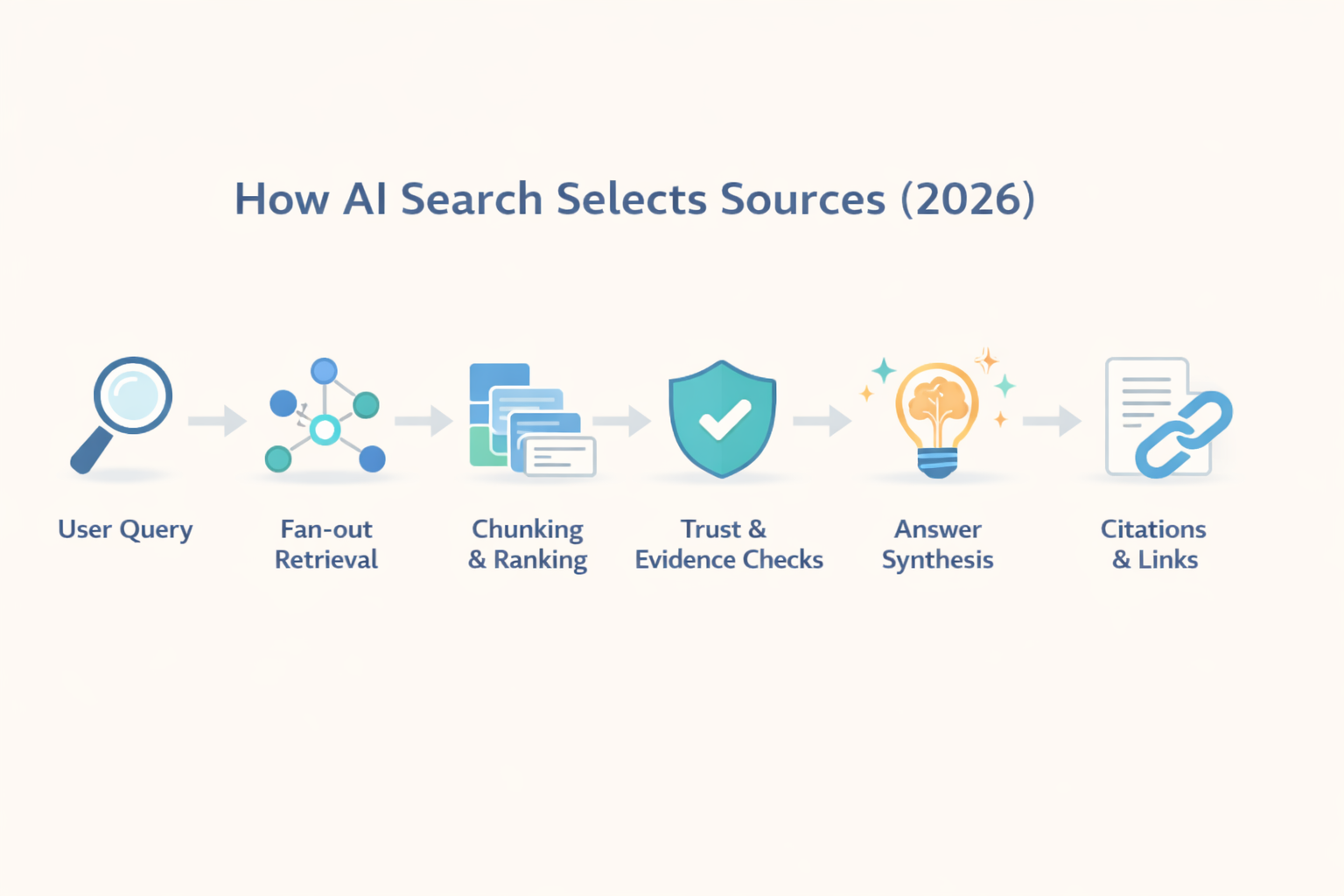
While each system is different, selection tends to converge around these repeatable drivers:
1) Relevance at Passage Level (Not Just Page Level)
Generative systems often retrieve and score chunks (passages) rather than whole pages. If your key answer is buried, you may rank - but not get cited.
Do this:
- Put the direct answer in the first 8–12 lines under the relevant heading
- Use crisp headings that match intent ("How to…", "Checklist…", "Definition…", "Pricing…", "Pros/Cons…")
2) Trust + Eligibility Fundamentals Still Decide Entry
For Google AI features, Google's own documentation is direct: standard SEO best practices remain relevant, and there are no special additional requirements - the page must be indexable and eligible to appear with a snippet.
Translation: if your technical SEO is weak, you will not even be in the candidate set.
3) Freshness Matters More Than Ever in AI Answers
Models are penalized for being wrong "today." If your topic changes quickly (AI tools, specs, pricing, policies), you must publish updates and visible "last updated" dates.
4) Accessibility and Machine-Readability Influence Whether Your Content Is Usable
If systems can't parse your structure cleanly (JS-only rendering issues, hidden text, broken semantics), you'll lose citations.
OpenAI also highlights that improving website accessibility helps their agent interpret structure (ARIA roles/labels for interactive elements). Perplexity likewise provides WAF guidance and emphasizes validating bots using both User-Agent and IP ranges.
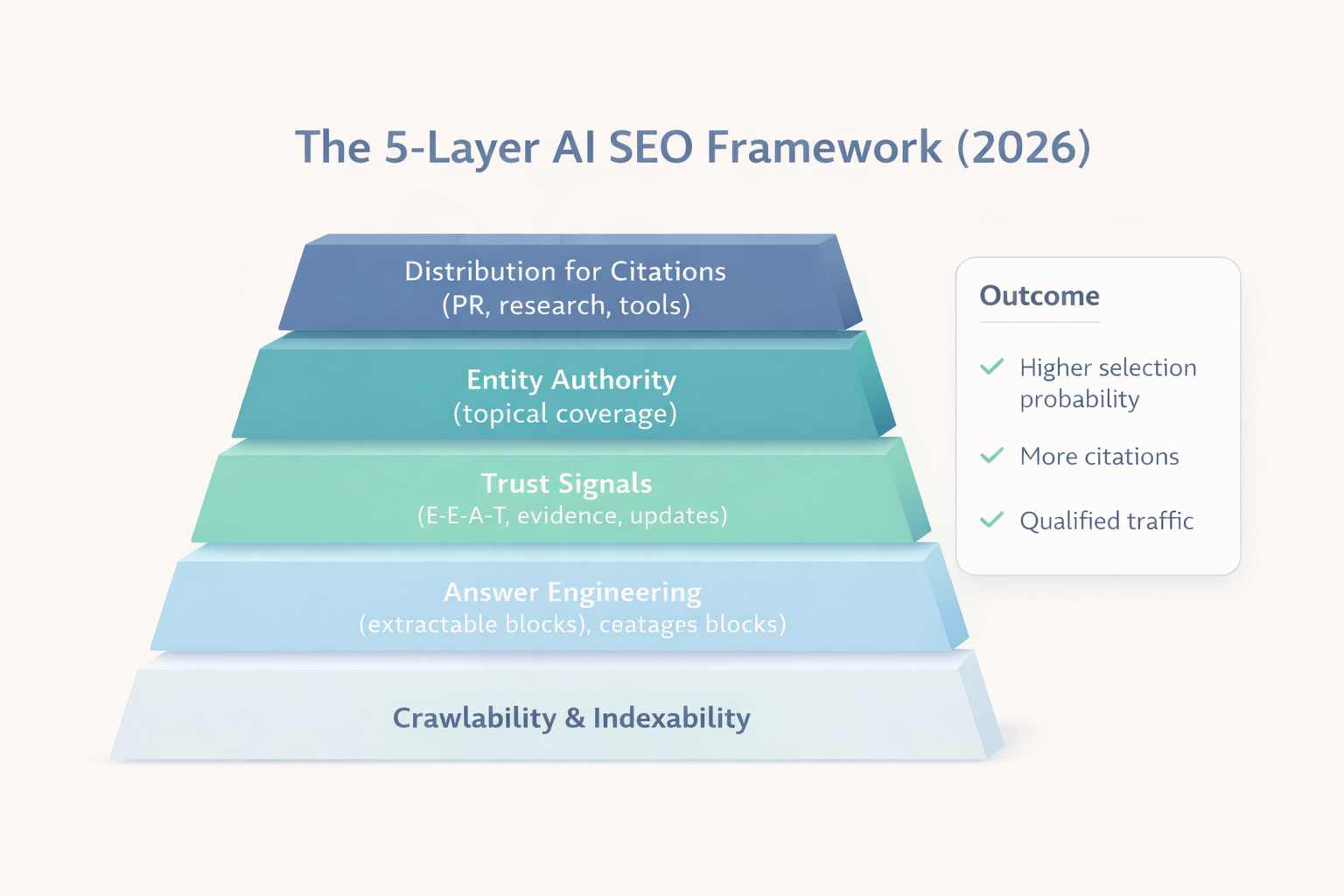
The 2026 AI SEO Framework: 5 Layers That Win Citations
Layer 1 - Crawlability & Indexability (Non-Negotiable)
Checklist
- Page returns 200 OK (no soft-404, no blocked resources)
- Not blocked by robots.txt (Googlebot, and optionally AI bots you want)
- Not noindex
- Canonicals correct
- Server renders meaningful HTML quickly (SSR / dynamic rendering if needed)
- Internal linking exposes the page within ≤3 clicks
Google explicitly calls out crawl allowance, internal links, page experience, and ensuring important content is available in text.
Layer 2 - "Answer Engineering" (Make Your Content Extractable)
This is where most teams fail.
Use this template inside the article:
- BLUF / Executive answer (2–3 sentences)
- Key takeaways (5 bullets)
- Process (numbered steps)
- Edge cases (when it doesn't apply)
- Examples (1–2 concrete mini cases)
- References / sources (outbound citations to primary sources)
Why this works: AI systems can lift a clean "answer block" with minimal risk of misrepresenting you.
Layer 3 - Entity-First Topical Authority (Be "The Source of Truth")
Classic keyword targeting is insufficient. You need entity coverage: the full map of concepts around "AI SEO in 2026," for example:
- AI Overviews / AI Mode
- Retrieval-augmented generation (RAG) concepts
- Chunking / passage ranking
- E-E-A-T, authorship, citations
- Structured data
- Robots controls for AI crawlers
- Measurement and analytics
Content architecture that wins:
- A pillar page (this article)
- 6–10 supporting articles covering specific subtopics
Layer 4 - Trust Signals That Models (and Humans) Can Validate
AI engines are reputation-sensitive. You must reduce "hallucination risk" for the model by making claims verifiable.
Add these trust assets:
- Named author with credentials, LinkedIn, and editorial policy
- "Last updated" date + change log for major revisions
- Clear sources for statistics (prefer primary sources)
- Real-world examples/screenshots (where applicable)
- About page + company contact details
- Transparent affiliate disclosures (if any)
Layer 5 - Distribution Engineered for Citations (Digital PR, Not "Link Building")
In AI search, being cited by other trusted sources increases your probability of being selected.
High-leverage plays:
- Publish original research (benchmarks, datasets, experiments)
- Create a free tool (calculator, checker, template)
- Produce "definitive" visuals (diagrams, frameworks)
- Earn mentions in industry newsletters and communities
- Syndicate summaries to LinkedIn + canonical back to your site
Platform-Specific Optimization
A) ChatGPT Search Optimization (2026)
What to do:
- Ensure you are not blocking OAI-SearchBot if you want inclusion in summaries/snippets
- If you want visibility without training, OpenAI distinguishes between:
- OAI-SearchBot (search surfacing)
- GPTBot (potential training crawl)
- Track ChatGPT referrals: OpenAI states ChatGPT includes
utm_source=chatgpt.comin referral URLs
Robots.txt Example (Visibility Allowed, Training Disallowed)
User-agent: OAI-SearchBot
Allow: /

User-agent: GPTBot
Disallow: /
B) Perplexity Optimization (2026)
Perplexity provides direct crawler documentation:
- PerplexityBot is designed to surface and link websites in search results and is "not used" to crawl content for AI foundation models
- Perplexity-User may visit pages for user actions, and their documentation notes this fetcher generally ignores robots.txt because it's user-requested
- They publish IP ranges and recommend combining User-Agent + IP validation in WAF rules
Practical implications:
- If you want to be cited, allow PerplexityBot and ensure your WAF isn't blocking it
- If you operate sensitive content areas, design controls beyond robots.txt where appropriate
Robots.txt Example
User-agent: PerplexityBot
Allow: /
C) Google AI Overviews & AI Mode Optimization (2026)
Google's official stance is straightforward:
- "The best practices for SEO remain relevant" for AI features
- "There are no additional requirements" and no special optimization needed to appear
- Eligibility requires the page to be indexed and able to appear with a snippet
- Structured data must match visible text; however, there is no special schema required specifically for AI features
- AI feature clicks are included in Search Console reporting as part of overall web search performance
What actually wins in practice:
- Clean answer blocks (definition, steps, comparisons)
- "People-first" content with evidence
- Strong internal linking (topical clusters)
- Updated pages for volatile topics (AI changes fast)
D) Bing / Copilot Optimization (2026)
Microsoft's public documentation for "generative answers" emphasizes that the system retrieves web information and returns grounded, cited responses.
Actionable moves:
- Publish clear, fact-based modules that are easy to cite
- Use schema + structured headings
- Keep brand/entity consistency across the web (About pages, profiles, citations)
The 12-Point AI SEO Checklist (Operational)
- Indexable, snippet-eligible page (no blocking, no noindex)
- Strong internal links from relevant clusters
- Executive answer block in first screen
- Descriptive H2/H3 that match intent
- Short paragraphs + lists + steps
- Examples + edge cases
- First-party data or original insights
- Author credibility + editorial policy
- Clear citations to primary sources
- Schema: Article + Breadcrumb + FAQ (matching visible text)
- AI crawler policy: allow/disallow bots intentionally
- Measurement: GA4 + Search Console + UTM segmentation
Measurement: What to Track
KPIs that matter in 2026 AI SEO:
- Brand mentions inside AI answers (manual sampling + monitoring tools)
- Referral sessions from:
utm_source=chatgpt.com(ChatGPT Search)- Perplexity referrers (watch source/medium patterns)
- Assisted conversions (AI traffic often converts after return visits)
- SERP footprint: pages that become "citation candidates" (topical clusters)
Google notes that sites appearing in AI features are included in overall Search Console traffic reporting.
Implementation Notes
- Do not hide the answer behind UX tricks (tabs, accordions with JS-only content, heavy client rendering)
- Do not stuff FAQs with content not present on the page (schema must match visible text)
- Treat "last updated" as a ranking asset for fast-moving AI topics
- Adopt a bot policy (visibility vs training) and encode it in robots.txt intentionally
Frequently Asked Questions
What is AI SEO (GEO) in 2026?
AI SEO (often called Generative Engine Optimization) is the practice of increasing the likelihood your content is selected, cited, and linked as a supporting source inside generative answers from systems like ChatGPT Search, Perplexity, Google AI Overviews/AI Mode, and Bing/Copilot experiences.
Do I need special schema to appear in Google AI Overviews?
No. Google states there are no special optimizations or special schema required for AI Overviews/AI Mode. Standard SEO best practices still apply, and structured data should match visible content.
How do I get my site to appear in ChatGPT Search?
OpenAI advises publishers to ensure they are not blocking OAI-SearchBot in robots.txt if they want their content included in ChatGPT Search summaries and snippets.
Can I allow ChatGPT visibility but block AI training?
Yes. OpenAI distinguishes between OAI-SearchBot (for search surfacing) and GPTBot (associated with training crawls). Many publishers allow OAI-SearchBot while disallowing GPTBot, depending on policy.
How can I track traffic from ChatGPT Search?
OpenAI states ChatGPT includes utm_source=chatgpt.com in referral URLs, which can be tracked in analytics tools like Google Analytics.
What content format is most likely to be cited by AI search engines?
Content that is extractable and defensible: direct answers near the top, structured headings, numbered steps, concise definitions, comparisons, and clearly sourced facts.
Ready to Implement AI SEO?
If you want, Advisable can turn this into a complete "AI SEO Engine" for your site:
- Technical audit for AI eligibility (crawl/index/render/schema)
- Content engineering templates for AI citations
- Topical authority roadmap (entity + cluster plan)
- Digital PR and research assets designed for citations
- Measurement dashboards (AI referrals + assisted conversions)