
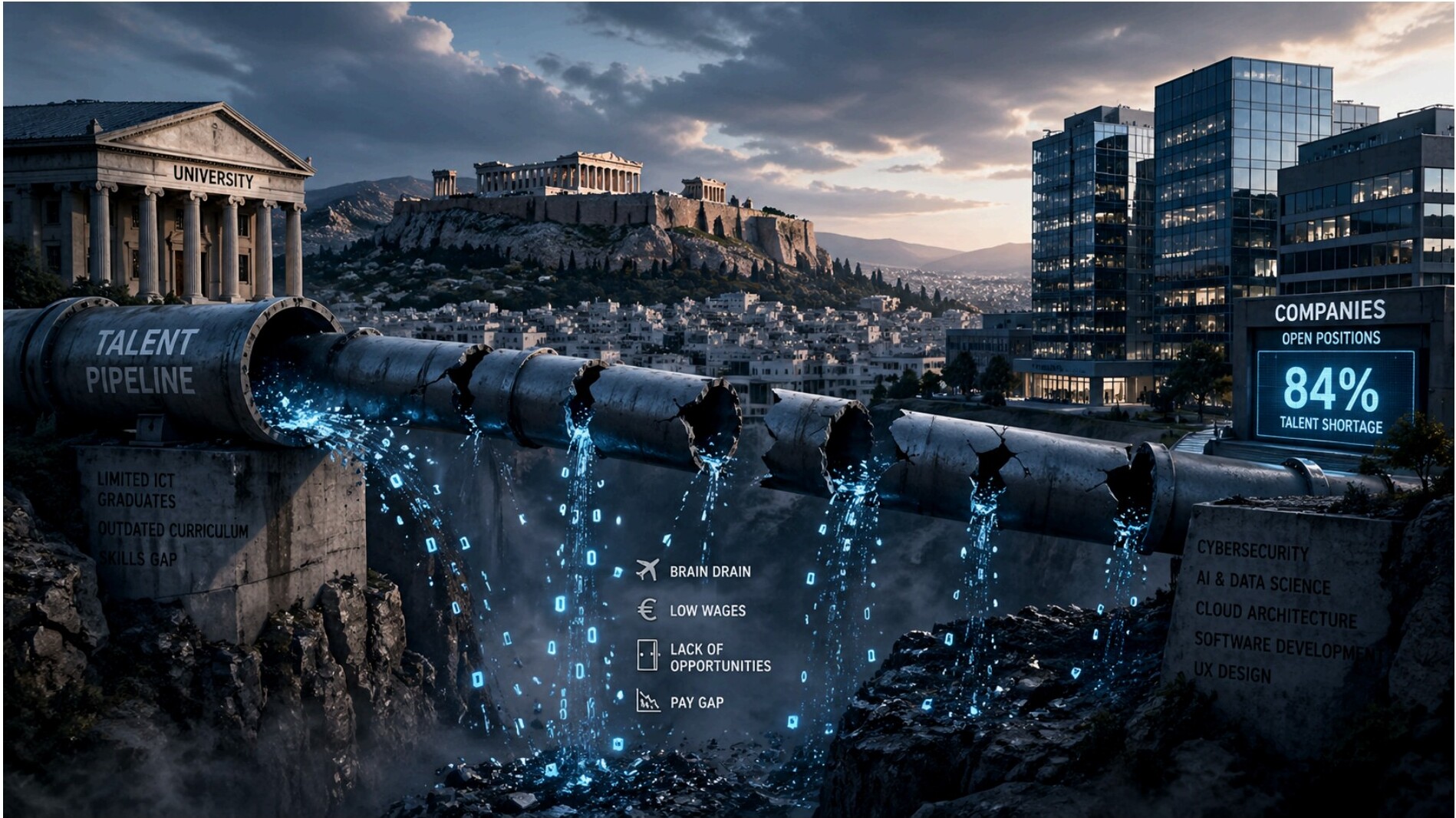
TL;DR 84% of Greek employers cannot fill open roles according to ManpowerGroup's 2026 Global Talent Shortage Survey, second in Europe, ahead of Germany and Portugal. The shortages are most acute in cybersecurity, AI engineering, cloud architecture, UX design, and software development. Three problems are stacking: the crisis decade emptied a generation of tech talent through emigration, the university system produces roughly half the ICT graduates the market needs, and productivity gains in the Greek economy are not reaching employee wages, a dynamic documented by KEPE and the Levy Economics Institute. Greece ranks last in the EU by purchasing power-adjusted wages, there are no pay transparency requirements to create accountability for the gap, and remote work has made the alternative visible to anyone with a laptop. The result is a market where talent either leaves, works remotely for foreign employers, or accepts conditions that drive quiet disengagement.
Greece Has a Talent Problem and the Numbers Are Specific
Greece is not simply part of a global trend. It is near the top of it.
ManpowerGroup's 2026 Global Talent Shortage Survey, conducted across 39,000 employers in 41 countries, places Greece at 84% difficulty filling open roles, tied with Japan and second only to Slovakia at 87% in Europe. Germany is at 83%, Portugal at 82%. For comparison, Finland sits at 60% and Poland at 57%. Greece is not in the middle of this problem. It is at the sharp end.
The Euronews coverage of the same survey adds a detail specific to Greece that does not appear in the headline number: Greece is the only country in the entire survey specifically flagged for a critical shortage of HR professionals, with 21% of employers citing this. That is diagnostic in itself. When companies cannot hire the people responsible for hiring, the problem is structural, not cyclical.
The European Commission's Greece 2025 Digital Decade Country Report, Brussels' formal annual evaluation of each member state's digital readiness, uses the word "severe" to describe Greece's digital skills gap, and specifically flags the shortage of ICT specialists as one of the country's top challenges. This is not an industry complaint. It is a government-grade assessment.
Which Roles Are Actually Missing
The aggregate 84% figure is useful as a headline. It is less useful for understanding what, specifically, is not being hired. The SEPE/Deloitte studies and sector-specific reporting make the picture concrete.
Cybersecurity specialists are the most immediately acute shortage. The NIS2 directive and the EU Cyber Resilience Act have created mandatory compliance obligations across banking, telecoms, healthcare, and the public sector that took effect in 2024–2025. Every major Greek institution now has a legal requirement to staff cybersecurity roles it could previously ignore. Security engineers, penetration testers, and compliance analysts are all in short supply, and the regulatory deadline has arrived without the supply to meet it.
Data Scientists and AI/ML Engineers are next. The demand is structural, every company that wants to integrate AI into its processes needs people who understand TensorFlow, PyTorch, LLMs, and MLOps. Greece has a very limited domestic base of these professionals. The Deloitte/SEPE December 2024 sector study identifies AI as the top technology priority for the Greek ICT sector over the next three years, named by 30% of ICT company executives, while simultaneously identifying "lack of skilled workers" as the primary challenge preventing progress on exactly that priority.
Cloud Architects and DevOps Engineers follow closely. Microsoft, AWS, and other hyperscalers have established or committed to data centers in Greece, which created local demand without creating local supply. AWS and Azure certifications carry immediate market value in 2026 Greece precisely because so few people have them.
UX Designers are a smaller but telling gap. Digitization in banking, fintech, e-commerce, and public services, requires usability capability that Greek employers are consistently unable to source domestically at the salaries they are willing to pay. This role sits at the intersection of the supply problem and the wage problem in a way that is particularly visible.
Software Developers broadly remain in shortage at every level. Levels.fyi data from March 2026 puts average software engineer total compensation in Greece at €27,884 annually. For context, a mid-level software developer in Poland or Romania, countries often positioned as lower-cost than Greece, earns €30,000–€35,000. Greece is not cheap for tech talent. It is just paying as if it were.
What's the Root Cause of This Talent Shortage?
The 84% figure describes a symptom. Three distinct problems created it, and they compound each other in ways that make the shortage harder to fix than any single policy or hiring tactic can address.
The Crisis Decade Emptied the Pipeline
The origin of Greece's current talent shortage is not 2026. It is 2010.
Following the sovereign debt crisis that began in 2010 and lasted through most of the decade, an estimated 600,000 Greeks emigrated, the largest sustained peacetime emigration in modern Greek history. The departures were not random. They were disproportionately concentrated among the young, the educated, and the professionally mobile: the exact people who would today be mid-career software engineers, data scientists, and product managers.
Primary destinations were Germany, the Netherlands, the United Kingdom, and other Northern European countries where salaries for the same work were two to three times higher.
The reversal is real but partial. Official Eurostat data cited by the Greek government in April 2025 shows that approximately 420,000 of the 600,000 who left have since returned. ELSTAT confirmed that Greece's net migration balance turned positive in 2023 for the first time since 2008, 118,816 arrivals against 76,158 departures.
The brain drain has slowed. What it left behind has not recovered.
The Greek tech professionals who left in 2012 and returned in 2023 spent eleven years building skills, experience, and networks in higher-functioning tech ecosystems. Some came back. Many are still abroad. And the cohort that would have stayed and built careers domestically during those years, the 2010–2020 generation, is significantly smaller than it should be.
The University System Cannot Keep Up
Even if the brain drain had never happened, Greece's educational system cannot supply enough ICT talent to meet current demand, let alone projected demand.
The SEPE/Deloitte ICT Sufficiency Study, a formal commissioned study by Deloitte on behalf of SEPE, the Federation of Hellenic ICT Enterprises, quantifies the gap precisely. Greece currently has approximately 160,000 ICT specialists. To meet its own digital transformation targets by 2030, the country will need 280,000–300,000.
That gap requires producing 15,000–16,000 ICT graduates per year. Greek universities currently produce approximately 8,000–8,500.
The pipeline delivers roughly half of what the market needs, and has been doing so for years.
Mordor Intelligence's Greece ICT Market Report projects a deficit of up to 76,000 IT specialists by 2030, even accounting for expected improvements in graduate output and return migration. The Cedefop 2025 Skills Forecast for Greece identifies ICT roles as among the highest-growth, highest-shortage occupational categories through 2035.
The reasons are structural. Computer science and engineering programs at Greek universities are not growing at the pace the market requires. Postgraduate programs are limited. There is no systematic fast-track from adjacent disciplines, mathematics, physics, economics, into technology careers, which the SEPE/Deloitte study specifically identifies as an untapped route.
The supply is not coming. Not at the scale or speed the market is demanding.
A Pay Structure That Does Not Pass Productivity On to Employees
This is the part of the conversation that Greek employers consistently avoid.
A senior UX designer at a company valued in the billions being offered €28,000 gross annually, approximately €1,484 net per month, is not an anomaly. It is consistent with what salary data shows across the market. Levels.fyi's March 2026 figures show the average software engineer in Greece earning €27,884 in total annual compensation. The 75th percentile software developer in Athens earns approximately €1,933 per month, per Glassdoor data from March 2026.
For comparison: a mid-level software developer in Poland earns €30,000–€35,000. In Romania, €25,000–€30,000. Both countries are routinely described as lower-cost alternatives to Greece for European tech hiring. Greece is paying below both.
Some employers argue that Greece's lower wages reflect lower productivity or lower cost of living. The data does not fully support this. KEPE, Greece's Centre of Planning and Economic Research, documents that productivity gains in the Greek economy have not been translating into employee wage growth. The Levy Economics Institute published a paper titled "Working Harder, Paying Less: Wage Suppression in Greece" in July 2025. Output is rising. Pay is not following.
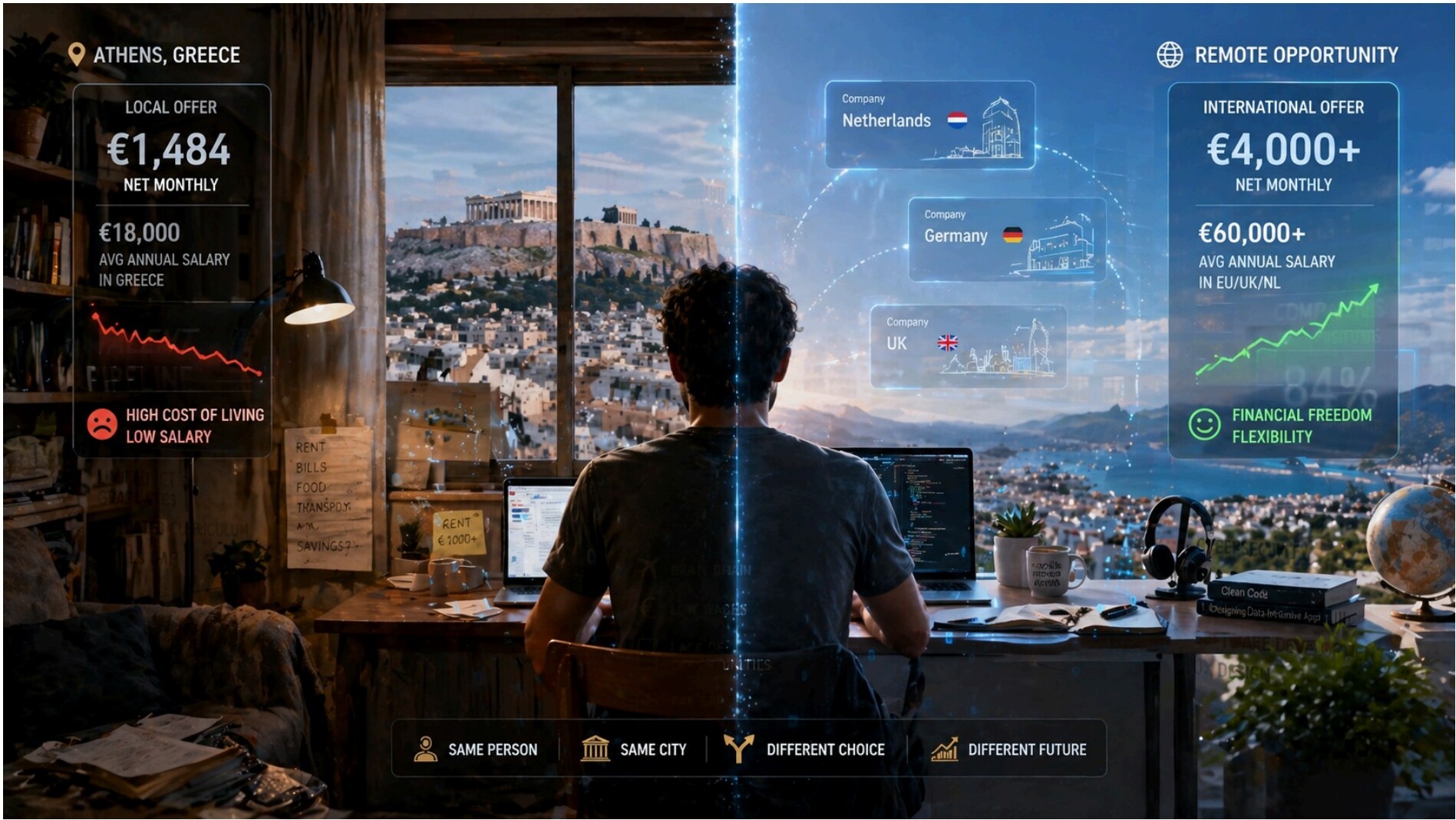
At the macro level: Greece's average annual salary stands at €18,000, against an EU average of €39,800, less than half, per Eurostat 2024 data. Adjusted for purchasing power standards, Greece ranks last among all EU member states.
The "cost of living offsets the salary" argument is partially true outside Athens. Inside Athens, it is no longer defensible.
A one-bedroom apartment in central Athens costs €900–1,100 per month. A net salary of €1,484 leaves approximately €300–500 for everything else. The compression that seemed rational when Athens was cheap is untenable in the city Athens has become.
One structural reason this goes unaddressed: Greece currently has no pay transparency or pay ratio disclosure requirements. The EU Pay Transparency Directive will eventually change this, but as of 2026 no Greek employer is legally required to disclose what its executives earn relative to its median employee. The imbalance is not just tolerated, it is structurally invisible.
Remote work has made the gap concrete and personal. A mid-level developer earning €1,800 net in Athens can switch to a remote contract with a Dutch company and double that figure, without changing their address, their city, or their timezone.
No Greek startup can realistically match those rates, and that is not the prescription. But the existence of that option has permanently changed what talented people in Athens are willing to accept from domestic employers. Companies that have not understood this are not losing candidates to local competitors. They are losing them to a choice that requires no airport.
What Founders Building Teams in Athens Should Actually Do
The pipeline is not closing on a timeline that helps anyone hiring in the next two to three years. Matching international freelance rates is not a realistic option for most Greek companies. What is realistic are the following adjustments.
Be transparent about what you are actually offering and why.
Candidates in Athens in 2026 know their options. Walking into a compensation conversation with a €28,000 gross offer for a senior role and leaning on "cost of living" as justification does not position you as a fair employer. It positions you as out of touch. If your budget is constrained, say so, and explain what else the role offers: equity, learning, title trajectory, flexibility. Candidates can weigh a real offer. They cannot work with a rationalisation.
Invest in developing adjacent talent rather than competing for the same scarce pool. The SEPE/Deloitte study identifies graduates from mathematics, physics, and economics as an underused pipeline into technology careers. Hiring a mathematically strong graduate and investing 12 months in their technical development is not a compromise. It is a strategy that produces loyalty, role fit, and skills calibrated to your specific stack, none of which a lateral hire from the same thin market guarantees.
Target the brain gain cohort actively.
Approximately 420,000 Greeks have returned from abroad since the crisis. A significant portion spent that decade building skills in higher-functioning tech ecosystems in Germany, the Netherlands, and the UK. They came back for personal or family reasons, not because the Greek job market became competitive. Many are underemployed relative to their actual capability. Reaching this cohort through Rebrain Greece and diaspora professional networks is a recruiting strategy most Greek companies have not operationalised.
In Summary
Greece's tech talent shortage has three causes that are routinely described as one. The emigration wave of the crisis decade removed a generation of professionals. The university pipeline has never been sized for the demand that digital transformation created. And productivity gains in the Greek economy are not being passed on to employees, a structural dynamic that suppresses salaries to the point where the pool of people willing to accept them is shrinking, with no legal mechanism currently forcing any employer to account for it.
Remote work made the exit visible. The educational pipeline will not catch up in time to solve the immediate problem and waiting for either to change is not a strategy.
Resources
- ManpowerGroup, "2026 Global Talent Shortage Survey": manpowergroup.com
- PRNewswire, "ManpowerGroup's 2026 Global Talent Shortage Survey — APME Press Release", February 26, 2026: prnewswire.com
- Euronews, "Talent Shortage: These Are the Hardest Roles to Fill in Europe", March 5, 2026: euronews.com
- SEPE / Deloitte, "Study on the Sufficiency of ICT Specialists in Greece": sepe.gr
- SEPE / Deloitte, "Prospects of the ICT Sector in Greece", December 2024: sepe.gr
- European Commission, "Greece 2025 Digital Decade Country Report": digital-strategy.ec.europa.eu
- Mordor Intelligence, "Greece ICT Market Share, Size & Growth Outlook to 2031", January 2026: mordorintelligence.com
- Eurostat, "ICT Specialists in Employment", April 2025: ec.europa.eu
- European Labour Authority / EURES, "Report on Labour Shortages and Surpluses 2024": eures.europa.eu
- Cedefop, "2025 Skills Forecast — Greece": cedefop.europa.eu
- ELSTAT (Hellenic Statistical Authority), Migration and Population Data 2024: statistics.gr
- China-CEE Institute, "Greece Monthly Briefing: The Reversal of Brain Drain in Greece", July 2025: china-cee.eu
- Eurostat, "European Salary Rankings 2024 — Average Annual Salary per Employee": ec.europa.eu
- Levy Economics Institute of Bard College, "Working Harder, Paying Less: Wage Suppression in Greece", July 2025: levyinstitute.org
- KEPE (Centre of Planning and Economic Research), "Labour Productivity and Compensation in Greece": kepe.gr
- Trusaic, "Greece's Path Toward Shrinking the Gender Pay Gap Under EU Directive" (pay transparency requirements context): trusaic.com
- Levels.fyi, "Software Engineer Salary in Greece", March 2026: levels.fyi
- PayScale, "Software Developer Salary in Greece 2026": payscale.com
- Glassdoor, "Software Developer Salary in Athens, Greece 2026": glassdoor.com
- OnOff.gr, "Top Digital Skills in Demand in Greece 2026", February 2026: onoff.gr