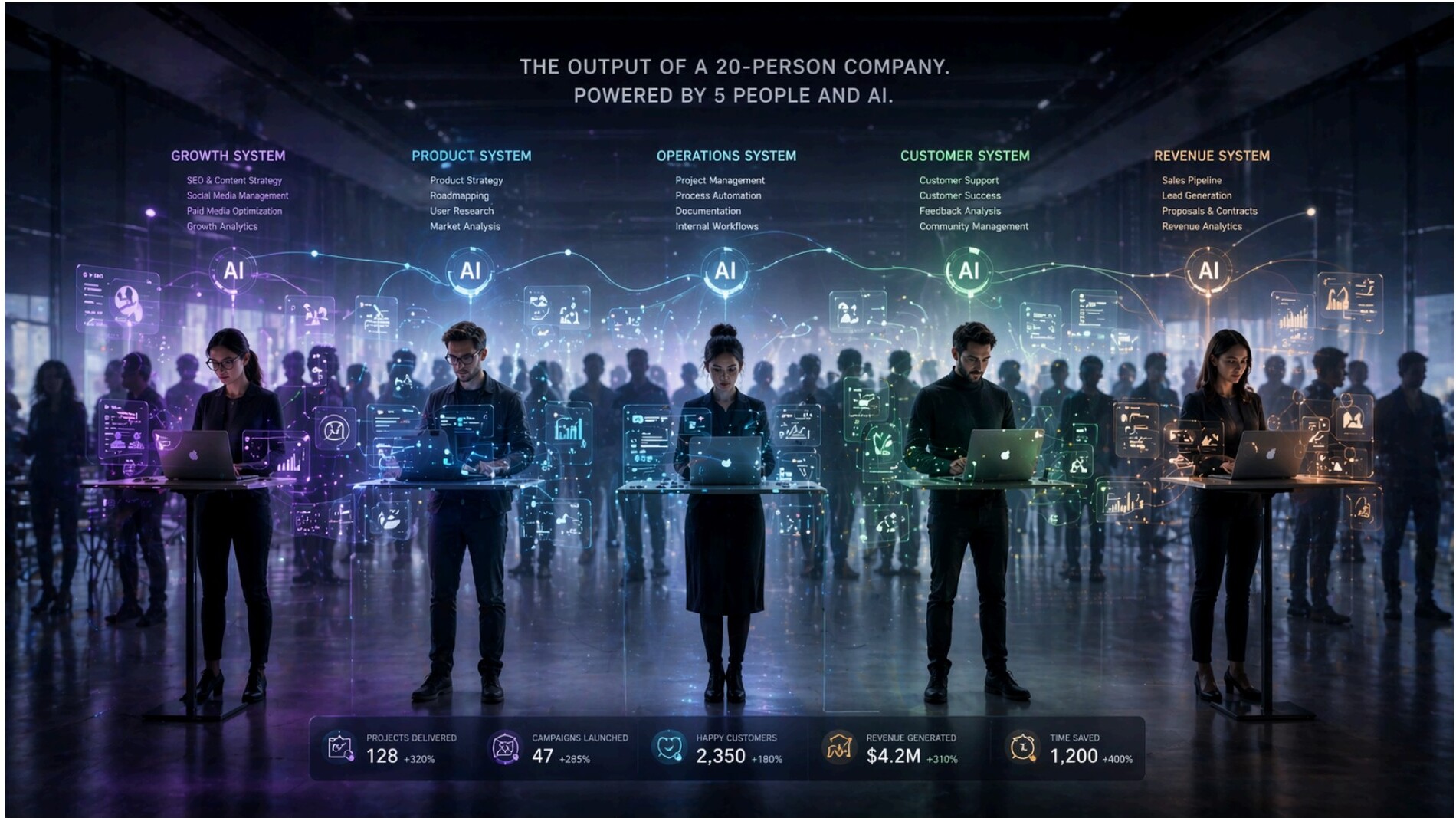
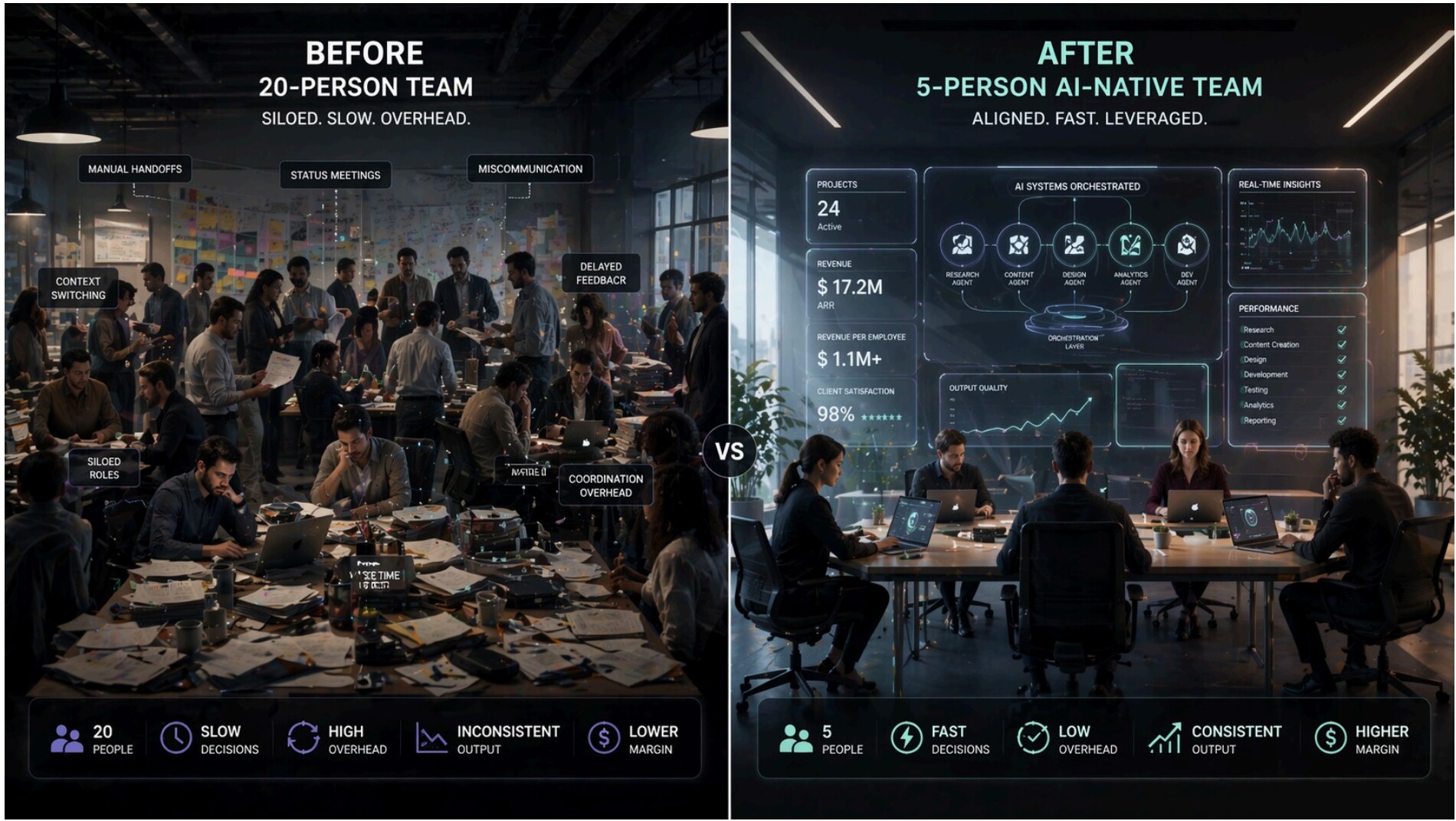
TL;DR Most small teams are not AI-native, they are traditional teams using AI tools. There is a meaningful difference. An AI-native team does not compress a 20-person org chart into 5 people. It eliminates entire organizational layers, junior roles, QA functions, dedicated research, separate content, ops coordination, and rebuilds around 5 operational systems, each owned by one person who orchestrates AI rather than executes tasks.
The result is not a more efficient small team, it is a structurally different company: one that handles the client load, output volume, and capability breadth of a 20-person organization, at a fraction of the cost and coordination overhead. This article explains what that model actually looks like, where it applies, and why most attempts to build it fail.
The Claim Needs to Be Honest Before It Can Be Useful
Small teams of 5 have always existed, in agencies of every kind, in startups, in consultancies, inside departments of large companies. A scrappy team where everyone wears multiple hats has been the default survival mode for small businesses across every sector for decades. So when someone says "5 people can now operate like 20," the obvious response is:
What exactly is new?
The traditional 5-person team covers its functions by being stretched. Scope gets limited, clients get deprioritized, and the business cannot take on more volume without quality degrading or the team burning out. It runs at 5-person output with 5-person capacity.
The AI-native 5-person team is not doing the same thing with better tools. Entire organizational layers that previously required dedicated headcount have been transferred to AI systems that each person orchestrates as part of their role.
The team runs at 5-person overhead with output and functional depth closer to 20. "Operates like 20" means higher capacity before the next hire, faster time to launch, more revenue per employee, and functional coverage that does not require outsourcing to fill gaps.
What Actually Changes: The Organizational Layers AI Transforms
The key insight most articles on this topic miss is this:
the leverage is not in making existing roles more efficient. It is in changing the ownership structure of entire functions, from dedicated headcount to AI-operated workflows with senior human direction.
To be precise about what this means in practice:
These functions do not disappear entirely. They transform. They go from being someone's full-time job to being a system that one senior person runs as part of a broader ownership mandate. That is a structural shift, not just an efficiency gain, and it has a real cost on each side of the ledger. Here is what that transfer looks like, function by function:
Junior roles become embedded AI workflows and the safety net goes with them.
The entry-level analyst, the research assistant, the junior copywriter, the junior developer, these are the people whose primary function is producing raw material for more senior people to review and refine.
In the 5-system model, that function is AI-operated. First drafts still happen. Research still gets gathered. Data still gets compiled. But there is no longer someone whose job is to catch the things the system owner misses at a junior level.
The safety net of a second pair of eyes on routine work is gone. The system owner carries that responsibility, which means they need to be honest about their own blind spots in a way that a traditional team structure never required.
The QA layer becomes targeted and universal coverage disappears.
Dedicated reviewers and QA engineers exist in traditional teams because no one person can produce work and review it with equal rigour. In the 5-system model, you are asking them to do exactly that, with AI handling first-pass quality, but the system owner making the final call on everything.
The function gets faster and more focused. What you lose is the independent eye. If the system owner has a consistent quality blind spot, no one is structurally positioned to catch it. That is the honest cost.
Research and analytics become self-service and institutional memory becomes fragile.
When research is a dedicated role, knowledge accumulates in a person over time. They know which data sources to trust, which trends to discount, which competitor moves are signal versus noise.
When research becomes an AI-assisted workflow any senior operator can run, that institutional depth is replaced by on-demand breadth. Faster. More coverage. Less accumulated judgment about what actually matters. Both are real.
Where the Old Model Breaks
Before describing the 5-system architecture, it helps to name the specific dysfunction it replaces, because without that contrast, the model reads as a configuration choice rather than a response to a real structural failure.
Picture a 20-person B2B company, it could be a consultancy, a SaaS business, a marketing firm, or an internal team inside a larger organization. It has:
- a content writer
- a SEO specialist
- a paid media manager
- a designer
- a developer
- a project manager
- a junior analyst
- a sales development rep,
- a customer success manager
- a handful of senior people coordinating all of them.
The team is functional. Work gets done.
Here is where it breaks:
The content writer produces content that the SEO specialist has not briefed, so it misses the search angle.
The paid media manager runs campaigns without input from the designer, so the creative underperforms.
The junior analyst produces reports that the senior people skim because the format does not match how they think.
The project manager spends 40% of their time chasing status updates that should be self-evident.
Every handoff between roles is a potential drop. Every briefing cycle is a delay. Every piece of work that crosses a role boundary carries coordination overhead and interpretation loss.
The 20-person company does not produce 4 times the output of a 5-person company. In most knowledge work contexts, it produces maybe 1.5 times the output and a disproportionate amount of the energy goes into keeping 20 people synchronized rather than into the work itself.
The 5-system model eliminates the handoffs, not by having fewer people do more, but by having fewer people own the entire outcome of a system, so there is no boundary to cross, no brief to misinterpret, no status update to chase.
The 5 Systems Model: Roles Are the Wrong Frame
The reason role-based org charts fail to capture what is new about this model is that roles describe what a person does in isolation. Systems describe how work flows through the organization toward an outcome.
In an AI-native team, each person owns a system, a set of outcomes, inputs, AI tools, and output standards, not a job description.
Here are the 5 systems every AI-native company needs, and what each one looks like in operation.
Product System
Outcomes owned: What gets built, when, at what quality.
What AI handles: Code generation, testing, documentation, bug triage, technical specifications, architecture review for standard patterns, QA of non-critical paths.
What the human handles: Architecture decisions for novel problems, product strategy, user research synthesis, prioritization, and the judgment calls on what to build next and why.
The constraint: This person needs to be genuinely senior, capable of making architectural decisions independently and catching AI-generated errors in technical output. The leverage multiplies experience; it does not replace it.
Growth System
Outcomes owned: Awareness, acquisition, and conversion.
What AI handles: Content production across formats, keyword research, campaign copy, ad creative iteration, email sequences, SEO execution, performance dashboards, competitor monitoring, and first-pass audience analysis.
What the human handles: Channel strategy, messaging architecture, offer design, partnership decisions, and the interpretation of data that doesn't fit the expected pattern.
The constraint: Content volume without strategic coherence is noise. The human who owns this system needs to understand the narrative the company is trying to build in its market, not just how to use the tools.
Customer System
Outcomes owned: Retention, satisfaction, and expansion revenue.
What AI handles: Ticket triage and first-response drafting, onboarding documentation, FAQ and knowledge base maintenance, churn signal detection from usage data, and routine customer communication.
What the human handles: High-stakes customer relationships, escalations, renewal conversations, qualitative feedback synthesis, and the strategic decisions that come from understanding what customers actually need versus what they say they need.
The constraint: AI-handled customer communication at volume can feel impersonal at exactly the moments when customers need to feel heard. The human in this system needs to be skilled at knowing when to step out from behind the AI layer and show up directly.
Revenue System
Outcomes owned: New business, proposals, and commercial relationships.
What AI handles: Prospect research, proposal drafting, competitive positioning materials, CRM hygiene, follow-up sequences, contract drafts for standard engagements, and financial modeling for pricing decisions.
What the human handles: Relationship development, negotiation, the judgment calls on which deals to pursue and which to decline, and the trust-building that turns a prospect into a long-term client.
The constraint: AI can draft a compelling proposal. It cannot build the kind of trust that makes someone sign a significant contract with a company they have just met. The human in this system needs to be commercially strong, not just comfortable with AI tools.
Strategy System
Outcomes owned: Direction, decisions, and organizational learning.
What AI handles: Competitive intelligence gathering, scenario modeling, board and investor materials, meeting preparation, research synthesis, and the documentation of decisions for organizational memory.
What the human handles: Everything that matters. Which market to enter, which product bet to make, which partnership to pursue, how to respond to unexpected competitive moves, and what the company should become.
This is the system AI assists most visibly and contributes to least meaningfully. The leverage here is in freeing the person who owns strategy from execution overhead, not in having AI make strategic decisions.
What This Actually Feels Like: The Messy Reality
The 5-system model is a clean framework. Real teams operating inside it are messier than the framework suggests, and the article would be incomplete without saying so.
In practice, the growth system owner ends up in customer conversations when a high-value prospect asks a technical question. The product system owner spends two hours debugging a marketing analytics pipeline because the growth owner hit a tool integration problem.
The revenue system owner pulls the strategy system owner into a client call that was supposed to be routine but turned complex. Ownership boundaries blur when things get hard, which is most of the time.
What the framework provides is not a clean separation of responsibilities, it provides clarity on who owns the outcome when the blur resolves. When the growth system produces inconsistent content for three weeks running, there is one person accountable for diagnosing and fixing it, not a chain of handoffs between a writer, an editor, and a strategist.
That accountability without diffusion is the actual structural advantage. The messiness is real. The clarity about who cleans it up is what changes.
A Real Anchor: What This Looks Like With Actual Numbers
The cleanest documented example of this model in operation is Lovable, a no-code app builder that reached $17 million in annual recurring revenue with a team of 15 people, three months after launch in late 2024. That is over $1 million in revenue per employee at a point in the company's life when most startups that size are still trying to find product-market fit.
Lovable is an outlier in terms of growth velocity, but it is not unique in its structural logic. Research tracking lean AI-native companies found that the best-performing cohort achieves $3.48 million in revenue per employee, six times higher than comparable non-AI SaaS companies, while operating with 40% smaller teams and reaching scale benchmarks a full year faster.
At the extreme end, BuiltWith has run at $14 million in annual revenue with a single employee. These are not hacks or exceptions. They are what the architecture produces when execution layers are transferred to AI and human capacity is concentrated entirely on judgment and direction.
The 5-system model is the organizational design behind those numbers, whether you are building a standalone 5-person company or restructuring a function inside a 500-person one.
Before and After: Three Contexts, Specific Numbers
Abstract models become real when you see what they replace. Here is what the 5-system model actually changes across three contexts, with specific operational comparisons.
Context 1: The Web Agency
An agency built on 5 systems handles the client load with 5 people rather than 20, because the junior account executive, the copywriter, and the SEO specialist no longer exist as separate hires.
Their functions live inside the Growth System and the Revenue System, operated by AI under human direction. Client capacity before the next hire increases from 8–10 to 15–18 clients, with more consistent output quality because the AI doesn't have bad weeks.
What does not change:
The creative director still needs taste. The developer still needs judgment on architecture. The account director still needs to be the person clients trust. The leverage is in the layers beneath them, not in replacing the senior capability.
Context 2: The SaaS Startup
A traditional SaaS startup getting to first paying customers in 2020 required: 2 engineers, a designer, a product manager, a growth marketer, a content writer, and a customer success person. Seven people before meaningful traction, at significant burn.
The same company in 2026 launches with 5 system owners. The content writer, the standalone PM/Designer role, and the junior engineer are AI-operated functions within the systems, not headcount. McKinsey's analysis of AI-era ventures found they are reaching significant revenue benchmarks 7 months faster than earlier cohorts with materially lower per-head cost.
For a 100-person or 500-person company, the model applies at the function level.
Why Most Attempts to Build This Fail
Mistake 1: Hiring generalists who are generalists all the way down.
System ownership requires the judgment to steer, not just the ability to operate. The people this model demands are rare; genuinely cross-functional, genuinely senior in at least one domain, willing to own outcomes rather than execute tasks.
If your team is still learning their domain, the 5-system model will amplify that inexperience, not compensate for it.
Mistake 2: Not writing down what each system owns.
The ambiguity of "just use AI to help" produces neither accountability nor quality. Each system owner needs a written architecture defining what they own, which AI tools cover which functions, what the output standards are, and how their work is measured.
Without that, ownership blurs and the coordination overhead the model was supposed to eliminate quietly returns.
Mistake 3: Measuring inputs instead of outputs.
The 5-system model cannot be evaluated by hours worked or tasks completed. It has to be measured by system-level outcomes like client retention rate, time to launch, revenue per employee, conversion rate.
If you are not tracking these, you cannot tell whether the model is working or whether you have built a more sophisticated version of a stretched small team.
The "Agent Boss" Is Not a Job Title, It Is a Capability Requirement
Microsoft's 2025 Work Trend Index introduced the concept of the "agent boss", a human who assigns tasks to AI agents, oversees their output, and integrates the results into higher-order decisions.
This is the operative description of what every person in the 5-system team actually does.
The implication is that the hiring bar changes fundamentally. The question is not "can this person do the technical work?" The question is "can this person direct AI to do the technical work, evaluate the output, catch what is wrong, and make the judgment calls that AI cannot?" Those are different skills, and in the current hiring market, they are rare enough to be genuinely differentiating.
The Harvard field experiment at Procter & Gamble found that AI was especially powerful for less experienced workers, helping them perform at levels closer to experts. But the mechanism matters:
they were able to reach that level because AI gave them access to expertise framing, not because AI replaced the need for judgment. The agent boss model works because the human is still making the decisions that require context, stakes, and accountability. AI is not doing the thinking. It is doing the work that was always too slow, too expensive, or too repetitive for the thinking to be worth it.
What This Model Costs You: The Real Tradeoffs
The 5-system model is not strictly better than a 20-person team. It trades specific things, and being honest about those tradeoffs is part of deciding whether this is the right architecture for your situation.
You trade depth for coverage.
Each system owner covers more functional ground than any specialist would, which means they cover it less deeply in some areas. A dedicated SEO manager with five years of focused experience will outperform a growth system owner directing AI on SEO, in the specific domain of SEO.
The bet the 5-system model makes is that breadth of ownership and cross-functional coherence produce better outcomes than depth of specialization, and for most early-stage companies and internal teams, that bet is correct. But it is still a bet, and there are domains where depth is non-negotiable. Know which domains those are in your business before you commit to the model.
You trade consistency for speed.
AI-assisted output at volume is faster and higher in quantity than a traditional team produces. It is not always more consistent. Quality bursts and dips depending on how well each system owner is directing the AI, how tired they are, how clearly the brief was set.
A 20-person team with defined processes and editorial standards can achieve more consistent output quality than a 5-person team where each person is simultaneously the strategist, the operator, and the quality reviewer. The 5-system model requires disciplined output standards per system, written, maintained, and enforced by the system owner, or consistency degrades.
The model has a ceiling and knowing where it is matters more than the model itself.
The 5-system model works best for companies and teams operating below a specific complexity threshold. As a rough guide:
it holds well up to roughly $3–5M in annual revenue for a standalone company, or up to 15–20 simultaneous client engagements for a service business, or up to a team function serving an internal organization of under 200 people.
Beyond those thresholds, the single system owner per function starts to become the bottleneck, not because the model is wrong, but because the complexity of the work exceeds what AI-assisted judgment can sustain without a second senior person in the system.
The model is not a permanent organizational structure. It is the right structure until the work complexity demands more than one judgment layer per system. The companies that use it well treat it as their operating model until they hit that ceiling, then hire a second senior person into the overloaded system rather than rebuilding the entire org chart from scratch.
The Real Competitive Advantage: What You Are Actually Building
AI doesn't make teams smaller. It removes the layers that made them large. What survives is judgment. Everything else becomes a system.
A 5-person company that operates like a 20-person company has one structural advantage that no larger competitor can easily replicate: zero coordination overhead.
In a 20-person company, a significant portion of everyone's time goes toward keeping 20 people synchronized; meetings, status updates, handoffs, approvals, and the organizational friction that scales with headcount.
The 5-system team does not pay for it. There are no handoffs between the content writer and the SEO manager, because they are the same system. There are no briefing cycles between strategy and execution, because the same person owns both.
The output of the 5-system model is not just higher than a traditional 5-person team. In the domains it competes in, it is often higher than a 20-person team, not because it has more people or more tools, but because it has less friction between intention and execution.
That is the structural shift the model represents. Not AI making small teams more capable. AI collapsing the layers that made larger teams feel necessary, and leaving behind a leaner, faster, structurally more coherent organization that competes on clarity rather than scale.
Resources
- Dell'Acqua, F. et al., "The Cybernetic Teammate: A Field Experiment on Generative AI Reshaping Teamwork and Expertise", Harvard Business School Working Paper No. 25-043 / NBER Working Paper 33641, March 2025: nber.org
- Dell'Acqua, F. et al., "The Cybernetic Teammate", SSRN full paper, March 2025: papers.ssrn.com
- Harvard Digital Data Design (D³) Institute, institutional summary of the Cybernetic Teammate study, 2025: d3.harvard.edu
- McKinsey & Company, "How to Build Businesses Faster and Better with AI", April 2026: mckinsey.com
- McKinsey Global Survey, "The State of AI 2025: Agents, Innovation, and Transformation", November 2025: mckinsey.com
- McKinsey Global Institute, "Agents, Robots, and Us: Skill Partnerships in the Age of AI", November 2025: mckinsey.com
- Microsoft & LinkedIn, "2025 Work Trend Index Annual Report: The Year the Frontier Firm Is Born", April 2025: microsoft.com
- Microsoft Work Trend Index 2024, "AI at Work Is Here. Now Comes the Hard Part", May 2024: microsoft.com
- Stanford HAI, "The 2025 AI Index Report", Stanford University Human-Centered Artificial Intelligence, April 2025: hai.stanford.edu
- Xiao, Q. et al., "AI Hasn't Fixed Teamwork, But It Shifted Collaborative Culture: A Longitudinal Study in a Project-Based Software Development Organization (2023–2025)", arXiv, September 2025: arxiv.org
- HubSpot Startups, "AI Statistics Every Startup Should Know", 2025 (AI-native startup revenue per employee benchmarks, team size data): hubspot.com
- The VC Corner, "The Billion-Dollar Startup Formula: Why AI-Driven Small Teams Are Beating Giants", March 2025 (Lovable, BuiltWith lean team data): thevccorner.com