Most startup failures trace back to weak validation. This article separates evaluation from true behavioral validation and provides a structured framework for testing demand before committing to development.
TL;DR: Much of what founders call "validation" is actually evaluation: interviews, surveys, and feedback that reduce uncertainty but never confirm real demand. True validation requires behavioral commitment: pre-orders, paid pilots, workflow switching, and ultimately revenue. This article presents a structured framework with three layers (evaluation, behavioral validation, revenue validation) and six practical methods to test demand before building anything. The key insight: interviews are evaluation, payment is validation, and retention is the strongest signal of all.
Product Building vs. Business Validation
For years, startup culture has repeated a mantra: validate before you build. It's good advice, but the word validate has become dangerously imprecise.
If you search for how to validate a startup idea, you'll find endless checklists: run interviews, create surveys, build an MVP, launch a landing page. Yet many founders follow these steps and still build products nobody adopts.
Why?
Because much of what is called "validation" is actually evaluation.
To understand how to properly validate a business idea before development, we must first separate two domains that startup discourse often merges: product building and business administration.
Product building, as a discipline, did not begin with Lean Startup.
Long before startup methodology became mainstream, the field of Human–Computer Interaction (HCI) had already established structured approaches to research, usability testing, prototyping, and iterative design. From the 1970s onward, user-centered design matured into formal engineering practice. In 1998, ISO 13407 codified the human-centered design process as an international standard (later evolving into ISO 9241-210), formalizing systematic research and evaluation methods.
In other words:
How to build a usable product has been methodologically defined for decades.
The Lean Startup movement, popularized by Eric Ries, introduced something different. It reframed startups as hypothesis-testing systems and used the language of validation to describe reducing market uncertainty.
That language stuck.
Evaluation vs. Validation: A Critical Distinction
In strict terms:
- Evaluation reduces uncertainty.
- Validation confirms commitment through behavior.
Most early-stage startup research (interviews, surveys, feedback collection) is evaluation.
When founders ask potential users whether they experience a problem, they are evaluating its existence. When they present mockups and gather reactions, they are evaluating perceived value. People may say one thing and do another. Interviews surface signals; they do not confirm behavior.
This is where confusion begins.
Over time, terms like problem validation and solution validation became common. Many founders equated positive conversations with proof of demand.
Yet if you have "validated" your startup idea and nobody buys, what happened?
What happened is that evaluation was mistaken for validation.
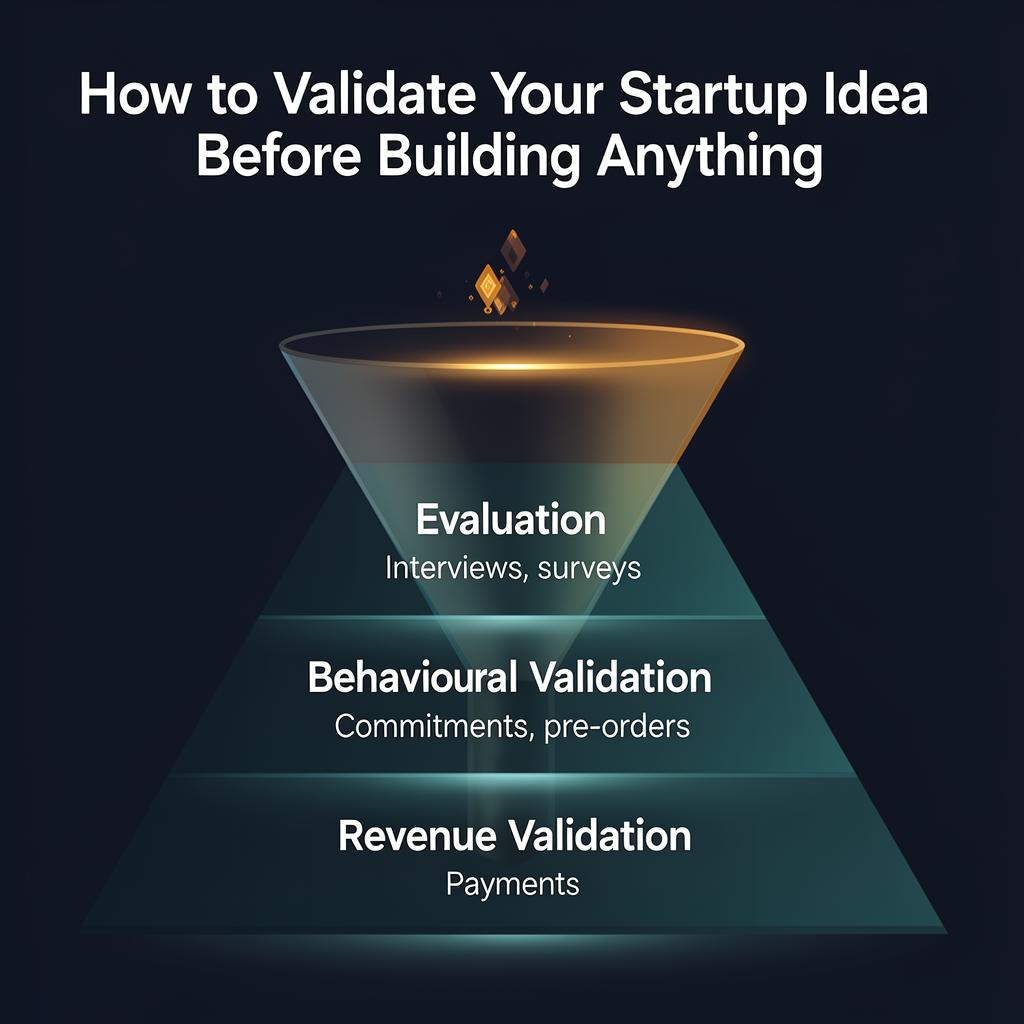
The Three Levels of Startup Validation
To clarify the startup validation process, distinguish three layers:
1. Evaluation (Signal Gathering)
- User interviews
- Surveys
- Observational research
- Competitor analysis
- Customer review analysis
- Market research
Evaluation helps determine whether a startup idea is worth exploring. It does not prove demand.
2. Behavioral Validation (Commitment Testing)
- Waiting list signups
- Pre-orders
- Paid pilots
- Letters of intent
- Time investment
- Workflow switching
Behavioral validation requires action. It introduces friction.
3. Revenue Validation (Market Proof)
- Money exchanged
- Subscription renewals
- Repeat usage
- Organic referrals
Revenue and retention are the strongest indicators of product–market fit.
Startups typically fail for structural reasons. The dominant ones are straightforward:
- They run out of funding.
- They build something the market does not adopt.
The second failure usually traces back to weak or improperly executed research, either insufficient user research or research that ignores established human-centered design practices.
Confusing evaluation with validation is not a separate failure cause. It is a symptom of inadequate research rigor.
Real validation requires risk.
It requires commitment.
It requires skin in the game.
Without behavioral evidence, you are still testing hypotheses.
How to Validate
Validating a startup idea without building a full product does not mean skipping research. It means progressing deliberately from evaluation to behavioral commitment.
Below is a structured startup validation framework optimized for early-stage founders.
1. Evaluate the Problem in the Wild
Before conducting interviews, observe existing user behavior. Look where users already speak freely:
- Reddit communities discussing tools and frustrations
- Facebook groups in niche industries
- Product reviews on competitor platforms
- App Store and Google Play feedback
- G2, Capterra, or Trustpilot reviews
- Slack and Discord communities
This is qualitative market research at scale.
Analyze:
- Repeated complaints
- Workarounds users describe
- Emotional intensity in language
- Frequency of pain points
- Gaps competitors fail to address
AI tools can accelerate this process:
- Summarizing hundreds of reviews
- Clustering complaints into themes
- Identifying sentiment patterns
- Extracting unmet needs
This stage helps evaluate whether your startup idea addresses a real, recurring problem.

2. Conduct Problem Interviews Without Selling
When validating a startup idea through interviews, avoid pitching your solution. Instead, reconstruct reality:
- When did the problem last occur?
- What was the impact?
- What solution did they use?
- What did it cost (time, money, reputation)?
- How frequently does it happen?
Strong problems show up in behavior and budgets. If someone cannot describe a recent instance, the signal is weak.
Interviews are essential for startup idea evaluation, but they remain evaluation, not validation.
3. Evaluate the Market Structure
A viable startup idea must exist inside an economic system.
Investigate:
- Who already pays to solve this problem?
- What budgets exist?
- Who is the economic buyer?
- What is the purchasing cycle length?
- Are there regulatory constraints?
Competitors indicate money circulation. No competitors may signal either opportunity or absence of demand.
This is market validation groundwork.
4. Test Behavioral Commitment Without Building a Full MVP
Modern tools make it possible to validate demand without full product development.
The goal is simple: move from opinions to actions.
Landing Page + Pre-Order
Create a focused landing page with:
- Clear value proposition
- Defined audience
- Transparent pricing
- Commitment-based CTA (deposit, paid beta, pre-order)
Traffic from ads or direct outreach allows you to test conversion behavior.
Clicks measure interest, while payments measure commitment.
Smoke Test
Run campaigns for a product not yet built.
Measure:
- Click-through rates
- Signup intent
- Attempted purchases
These tests demand intensity before development.
Concierge MVP
Manually deliver the promised outcome.
If your startup idea automates reporting, produce reports manually. If it offers AI insights, generate them semi-manually.
Charge from the beginning.
This validates demand for the result, independent of technical implementation.
Wizard of Oz Testing
Users believe the system is automated while a human performs backend operations.
This is useful when automation would require significant engineering investment.
Repeated usage and payment validate outcome desirability.
Paid Pilot Programs (B2B)
Offer structured pilot programs:
- Defined time frame
- Clear KPIs
- Paid engagement
Free pilots generate curiosity while paid pilots generate serious evaluation.
Fake Door Testing
Add feature buttons that do not yet exist. Measure click behavior and follow up with interested users.
This validates feature-level demand before development.
Switching Tests
Ask users to:
- Pause their current solution
- Try your alternative
- Migrate part of their workflow
Behavioral switching is a strong market validation signal.
5. Measure Demand Strength, Not Just Demand Presence
Once behavioral commitment appears, the next question is:
How strong is the demand?
Validation is not binary. It is a spectrum.
Differentiate between:
- One-time payment
- Recurring subscription
- Retention after three months
- Expansion across teams
- Organic referrals
Startup validation becomes meaningful when:
- Customers renew
- Usage frequency increases
- Integration deepens
- Revenue grows without proportional marketing spend
This is where product–market fit begins to emerge.
6. Distinguish Usability from Market Demand
Human-centered design ensures usability.
Market validation ensures sustainability.
A product can pass usability testing and still fail commercially.
Usability answers: Can users use it?
Validation answers: Will users pay and continue using it?
Confusing these questions leads to strategic misallocation of resources.
A Structured Startup Validation Framework
To validate a startup idea before building anything:
- Observe real-world user behavior.
- Evaluate problem intensity and recurrence.
- Analyze economic viability.
- Test behavioral commitment with minimal infrastructure.
- Measure demand strength and retention.
- Progress toward paid engagement as early as responsibly possible.
You cannot eliminate uncertainty in early-stage entrepreneurship but you can replace illusion with evidence.
Interviews are evaluation.
Compliments are evaluation.
Surveys are evaluation.
Commitment is validation.
Payment is stronger validation.
Retention is the strongest signal of all.
The difference between feeling validated and being validated is where real startups are built.