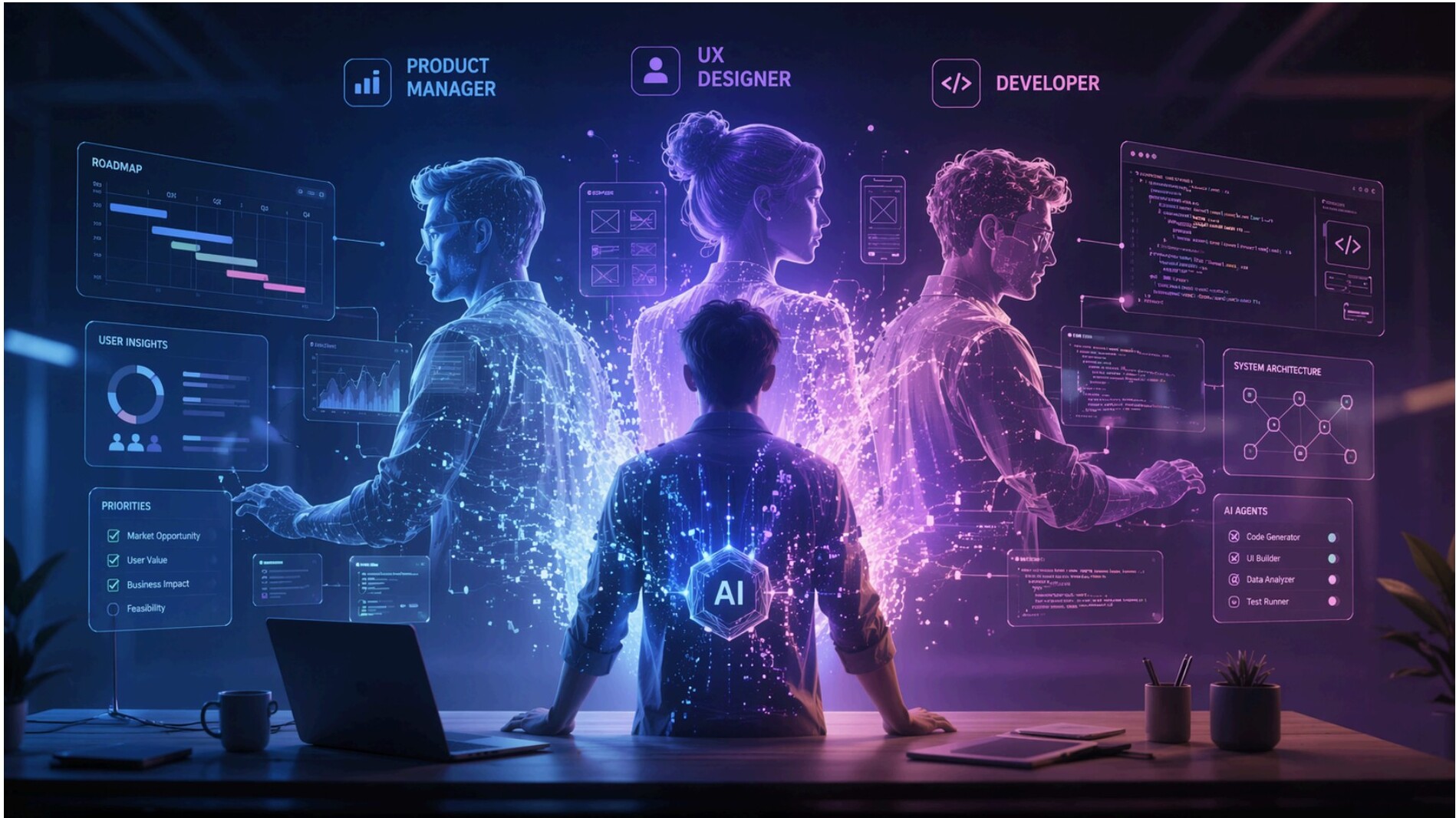
TL;DR: For decades, building a digital product required three distinct people: a product manager to decide what to build, a UX designer to research users and decide how the product should work, and a developer to build it.
Agentic engineering, orchestrating AI agents to build products rather than writing code directly, has made it possible for a single person to do work that previously required all three. Three professional profiles are competing for this role. The developer has the technical fluency. The product manager has the strategic context. The UX designer has something neither of the other two typically has: training in how humans actually interact with systems.
That training, specifically in HCI and HCD, not in the design thinking methodology that dominates most current curricula, turns out to be the qualification most directly aligned with the dominant failure mode of agentic engineering: not broken code, but output that works technically while failing the people who use it. The catch is that the bootcamp generation of UX designers do not have it either.
The Shift That Created the Question
In February 2025, Andrej Karpathy coined "vibe coding": describe what you want, accept the output without reviewing it carefully, iterate by feel. Useful for throwaway prototypes. By February 2026 he had retired the term himself, replacing it with "agentic engineering."
The distinction matters because vibe coding delegates ownership to the AI, while Agentic engineering means orchestrating agents while retaining full responsibility for what they produce; architecture, quality, and the judgment calls about whether the output is fit for real users. The word "engineering" is deliberate. It implies expertise, not just prompting.
That shift created a question that has not yet been answered clearly:
When one person takes ownership of a product across all three traditional domains, which professional background actually prepares them for it?
The data shows this is not a hypothetical. In Y Combinator's Winter 2025 cohort, 21% of companies had codebases that were 91% or more AI-generated. Across active agentic coding tools, 63% of users are non-developers; product managers, founders whose attention is fragmented across every domain simultaneously, and designers building full-stack products through natural language. The three-role model is already dissolving. The question of who should replace it is open.
The barrier to building dropped to near zero. The barrier to building something that actually works for real users stayed exactly where it was.
The Developer's Claim
The developer's case is intuitive. They understand how systems are built, can recognise when AI-generated code carries architectural or security risks, and are comfortable operating at the level of infrastructure and logic that agentic tools expose.
The security argument is real, because studies on AI-generated code found vulnerability rates around 45%, and knowing which of those matters, requires engineering judgment.
The limitation is equally clear. A developer who can build does not automatically know what to build or for whom. Agentic engineering produces output at a speed that makes the generation step trivial and what remains consequential is whether that output actually solves a real user problem, in a way that real users can understand and trust.
That evaluation requires knowledge of how humans perceive and interact with systems, knowledge that is not systematically part of standard software engineering training.
The Product Manager's Claim
The PM's case is also intuitive. They own the product vision, understand business constraints, and are trained to prioritise. In theory, they know what to build. In practice, they have long been doing something else as well.
NNGroup's 2021 research, conducted across 372 PM and UX professionals, found that from UX practitioners' perspective, almost every adjacent role overlaps with their work more than rarely. Among cross-functional roles specifically, product managers scored highest at 2.7 out of 4 on frequency of intrusion. The finding is not incidental:
It means PMs are routinely doing UX work without UX training. The role description and the formation diverged, not at the margins but as standard practice across the industry.
The PM who builds with agentic engineering carries that same gap forward, now with significantly more execution power. They can decide what to build. They are not systematically trained to evaluate whether what was built will work for the people using it, because that evaluation requires understanding how users form mental models, where those models break down, what trust in automated systems actually depends on, and how to detect when an interface that looks correct will produce errors in use.
That is not business training. It is human factors training.
The UX Designer's Claim and Its Condition
The UX designer's case is the strongest, but it comes with a condition that most current job titles do not satisfy.
A UX designer with genuine HCI training approaches a product as a system mediating between two other systems: the organisation and the user.
They understand the research methods for identifying what users actually need rather than what they say they want. They are trained to evaluate outcomes against user behaviour, not against stakeholder consensus.
They know how to identify the specific, predictable ways a system will fail a particular kind of user before that failure happens in production. When applied to agentic engineering, that formation is directly relevant:
The core judgment call; does this AI-generated output actually work for the person who will use it? is precisely the question HCI exists to answer.
The condition is the word "genuine." NNGroup's 2025 assessment of the UX field noted that UX job postings had dropped to approximately 70% of their 2021 levels as of 2023, with many practitioners migrating toward product management.
The market was signalling that the standard UX profile was not what was being demanded. What the standard profile means, in most cases, is someone trained in design thinking and interface tools, not in the cognitive science and empirical methods that HCI requires.
Two clarifications matter here, because they are genuinely unknown to many working professionals, including most of the product managers this article is addressing.
Human-Computer Interaction is the academic and scientific discipline that studies how people interact with digital systems. It draws on cognitive psychology, perceptual science, and human factors research to explain why systems succeed or fail with real users.
Human-Centred Design is the structured process that applies those principles when building digital interfaces, iterative, evidence-driven, and evaluated against actual user behaviour rather than internal opinion. HCD has been an international standard since ISO 13407 was published in 1999, revised into ISO 9241-210 in 2010 and updated in 2019.
The standard exists, is documented, and predates every UX bootcamp by over a decade. The fact that most product managers, and many designers, are unaware of its existence is itself diagnostic of how far the industry drifted from the discipline it claims to practise.
The scale of this problem matters and is rarely stated directly. A review of major UX bootcamp curricula shows consistent emphasis on process and tooling; journey mapping, wireframing, usability testing scripts, with limited to no coverage of cognitive psychology, human factors, or formal HCI methods. The dominant pipeline of the past decade is approximately 450 hours of instruction built around Design Thinking as a facilitation process. It teaches how to run workshops, generate ideas in groups, and produce wireframes and prototypes.
It does not teach cognitive psychology, perceptual science, mental model formation, human error analysis, or the empirical framework for evaluating why a system fails users in specific and predictable ways. Design Thinking is a facilitation methodology. It is useful for getting stakeholders in a room.
It is not a scientific framework for understanding human behaviour under load, with uncertainty, or in the presence of automated systems making consequential decisions on their behalf.
The origin of this gap is specific. The first generation of UX bootcamps, emerging around 2010 to 2013, were built predominantly by two kinds of people: business owners optimising for enrolment volume, and instructors whose own formation was in graphic design, visual communication, or fine art.
The Problem Even a Hybrid Cannot Solve
The three sections above address formation gaps, what each profile was never trained to do. There is a separate and complementary problem worth naming, because it preempts the most common objection: what about someone who has trained seriously across more than one domain?
The objection is legitimate and such people exist. The problem is not that multi-domain capability is impossible. The problem is that expertise is not just acquired, it is actively maintained.
Research on skill decay and expert performance is consistent on this point: professional-level judgment in a domain requires continuous, domain-specific practice to remain sharp. When that practice stops or becomes irregular, performance degrades; not immediately, and not uniformly, but reliably.
A full-stack engineer who moves heavily into product work finds their backend instincts dulling within months. A researcher who spends a year doing primarily visual design loses fluency in behavioural analysis. This is not a failure of intelligence or commitment, it is how expertise works.
The practical consequence for multi-domain practitioners is uneven depth. Most people who operate credibly across two or three domains have genuine strength in one and maintained-but-degraded competence in the others.
They are generalists with peaks, not specialists across the board. In a world where execution was the bottleneck, that unevenness was manageable, the weaker domains could be covered by specialists on the team. Agentic engineering removes that buffer. When one person owns the full stack from prompt to production, the weakest domain in their profile becomes the primary source of failure. And the domain where failure is hardest to detect, because the output looks correct while silently misserving users, is the human interaction domain.
That is precisely where uneven expertise is most dangerous, and precisely where HCI training is most irreplaceable.
What the Google Signal Confirms
In October 2025, Google eliminated more than 100 design and UX research roles from its Cloud division, cutting some teams by up to 50%. The roles cut were in quantitative user experience research and platform experience teams, the work of synthesising behavioural data at scale, generating design variants, and documenting usage patterns. The senior researchers, whose function was to evaluate whether the product worked for users and explain why it did not, were retained.
This is consistent with a broader pattern in which AI absorbs the automatable end of knowledge work while leaving judgment intact. What survives in every restructured function is the capacity to evaluate output against what humans actually need. What gets absorbed is everything that can be approximated by pattern recognition and synthesis.
The implication for the three-candidate question is direct:
The developer and the PM, each approaching the role from the side that AI is absorbing fastest, face a growing gap between their formation and what the role actually requires.
The UX designer with genuine HCI training is approaching it from the side that AI has not absorbed, the human judgment side.
That is the formation closest to what agentic engineering actually demands. The signal is clear: the role being created by agentic engineering is not the junior end of any of the three traditional disciplines. It is the judgment capacity that sits above all of them and the job title is not a reliable signal that the formation is present.
The Judgment Problem That AI Cannot Solve
There is a specific failure mode that no amount of better tooling eliminates, and understanding it is essential to understanding why the qualification question is hard.
Agents produce output that is syntactically correct, visually coherent, and fluent. Those surface qualities are precisely the cues that human cognitive systems use to infer deeper soundness. The fluency heuristic, the tendency to rate easily processed information as more accurate and trustworthy, is well documented.
So is automation bias:
The tendency to over-rely on automated outputs and under-scrutinise them when they appear confident and well-formed. A person evaluating AI-generated products without trained awareness of these biases will consistently approve output that passes on appearance and fails on substance.
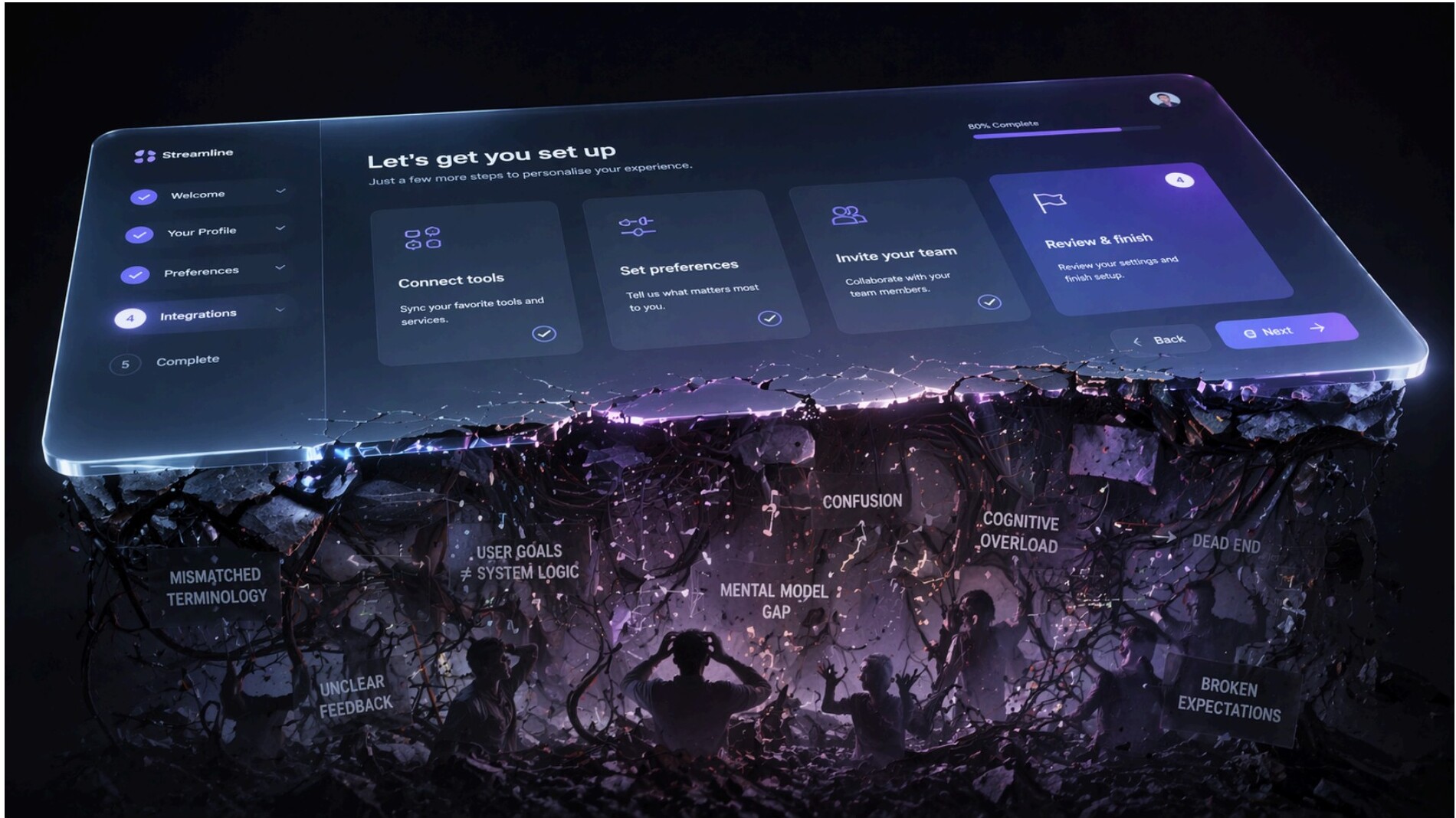
Consider a concrete case. An AI-generated onboarding flow looks complete:
- clear labels
- logical step progression
- clean visual hierarchy
A developer reviews it and ships it. A PM reviews it and approves it. Three weeks after launch, drop-off at step three is at 60%. The cause is a mental model mismatch, the interface uses system terminology that maps logically to the database architecture but does not match how users conceptualise the task they are trying to complete. The screen looks correct. The failure is invisible until it produces data.
An HCI-trained reviewer would have caught it before it shipped, because identifying the gap between a system's conceptual model and a user's mental model is not an instinct, it is a trained analytical method with a documented framework behind it. Neither the developer nor the PM had that framework and the AI certainly did not supply it.
This is not a general intelligence problem but a training problem. Knowing that you are susceptible to automation bias does not protect you from it. What protects you is systematic practice in recognising the specific conditions under which your own judgment is unreliable, which is what cognitive psychology and human factors training are designed to produce.
Most product managers have not had that training. Most bootcamp-trained UX designers have not had it either. The people who have are human factors practitioners and HCI researchers, a population that is substantially older, frequently invisible to standard hiring pipelines, and rarely described by the job titles that recruiters are currently scanning for.
This is precisely the failure mode that neither a traditional PM, a bootcamp-trained UX designer, nor a developer focused on shipping will reliably catch.
The Profile That Wins and Where to Find It
The person best equipped for this emerging role has four things:
- HCI training, formal or rigorously self-acquired, grounding decisions in how humans perceive and relate to systems.
- HCD knowledge from the research tradition, meaning the ability to evaluate outcomes against real user behaviour rather than process compliance or stakeholder approval.
- Trained critical thinking applied specifically to AI output, including systematic awareness of the cognitive biases that activate when evaluating fluent, automated results.
- Enough technical literacy to recognise when output that appears correct carries risks that will only surface in production.
Some companies are already naming versions of this role. Analysis of post-restructuring hiring signals identified two emerging titles: "AI Product Architect", owning model selection, evaluation strategy, and quality governance per feature and "Design-ML Partner", blending UX systems knowledge with prompt libraries, guardrails, and evaluation datasets.
Neither title is widespread. Most organisations are not calling it anything, they are noticing that one person is doing what used to require three.
The candidates who best fit this profile are not primarily visible in current UX, PM, or engineering hiring pipelines. They are more likely to be found among people who completed HCI master's programmes, worked in human factors, or built their formation through the research tradition before the current wave of lighter training became dominant.
Many of them predate the job title inflation that turned "UX" into a broad descriptor covering everything from visual polish to interaction architecture. Many are not recognised by recruiters optimising for Figma portfolios and agile certifications.
The historical job title that most closely matched this profile was Cognitive Engineer, a role that evolved through Usability Engineer and UX Architect before the current dilution. The knowledge that title represented did not disappear.
Agentic engineering does not eliminate the need for expertise, it concentrates it. And the expertise it concentrates is not the ability to produce systems; it is the ability to understand how those systems fail for the humans who use them.
Resources
- The New Stack, "Vibe Coding Is Passé, Says the Man Who Coined the Term", February 2026: thenewstack.io/vibe-coding-agentic-engineering
- NNGroup, "UXers and Product Managers Both Say Others Intrude on Their Work", April 2021: nngroup.com/articles/ux-product-managers-overlap
- NNGroup, "The UX Reckoning: Prepare for 2025 and Beyond", January 2025: nngroup.com/articles/ux-reset-2025
- CNBC, "Google Cuts More Than 100 Design-Related Roles in Cloud Unit", October 2025: cnbc.com/2025/10/01/google-cloud-unit-layoffs
- ISO, "ISO 13407:1999 — Human-Centred Design Processes for Interactive Systems": iso.org/standard/21197
- ISO, "ISO 9241-210:2019 — Ergonomics of Human-System Interaction: Human-Centred Design for Interactive Systems": iso.org/standard/77520
- Advisable, "From Vibe Coding to Agentic Engineering": advisable.com/insights/from-vibe-coding-to-agentic-engineering